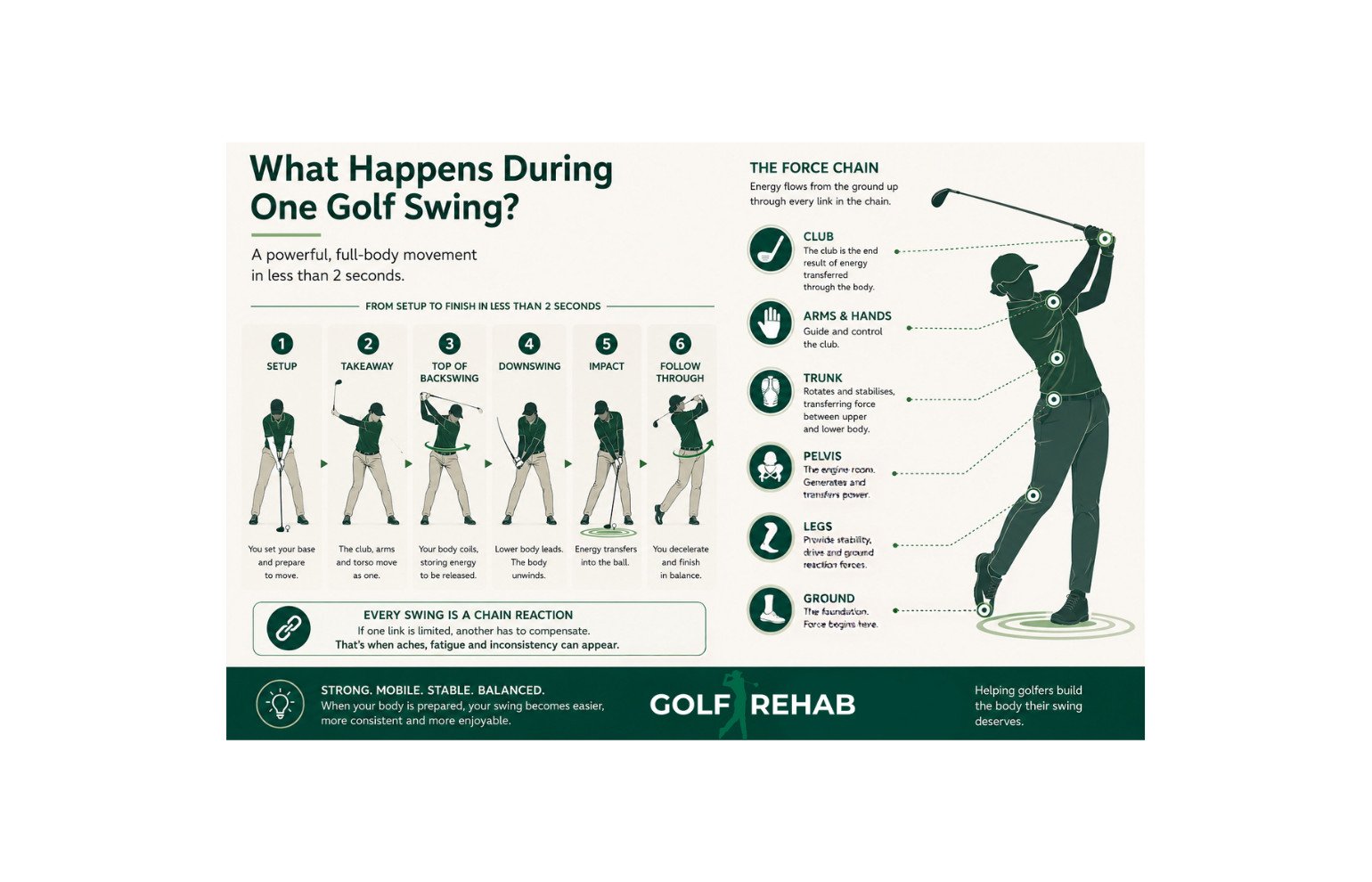

Quick answer: You probably need a proper assessment, not just more stretching. If your golf back pain keeps returning, eases off once you've warmed up, feels worse on one side, builds as the round goes on, hasn't improved with mobility work, only shows up during golf, or you've simply never had your movement checked. In most of these cases, the real driver is load, strength, or control, not tightness.
Why Golf Back Pain Spikes During Peak Season
The weather picks up, the courses dry out, and suddenly you’re playing way more golf than you have all winter.
For a lot of golfers, that jump in playing frequency comes with a side effect nobody wants: back pain.
Maybe you’re stiff getting out of the car after a round. Maybe your lower back aches the next morning. Or maybe it’s a nagging pain that eases off once you’ve warmed up, then turns up again the next time you play.
More rounds and more range sessions in a short space of time is usually when a stiff back after golf turns into something more persistent. Your body’s coping with a sudden jump in demand, and recurring lower back pain after golf is often the first sign it can’t quite keep up.
The usual response? Stretch more.
Stretching has its place. But it’s not always the fix golfers think it is. I’ve seen plenty of people spend months stretching the same spots and never get to the bottom of why they’re dealing with back pain after golf.
What Golfers Often Get Wrong About Back Pain
Here’s the biggest misconception I come across: pain means you’re tight.
If your back feels stiff, it seems obvious you need more flexibility. Sometimes that’s true.
More often, the issue isn’t a lack of movement. It’s a lack of control, strength, endurance, balance, or the ability to actually use the movement you’ve already got.
I’ve assessed golfers who can touch their toes, rotate well through their hips and thoracic spine, and still get recurring back pain. Flexibility was never the problem. The problem was that their body couldn’t hold those positions under golf-specific load and speed.
This is a pattern I see often: someone stretches diligently for months, sees a physio for general mobility work, and still gets the same back pain during the golf swing every time they play. It’s only once we look at strength, control, and how their body copes under golf-specific load that things actually shift.
That’s why generic stretching programmes so often fail to give lasting relief.
Why Stretching Alone Doesn’t Solve Every Golf-Related Back Issue
Think of your body like a Formula 1 car. If a tyre’s wearing unevenly, polishing the bodywork isn’t going to fix it.
Same with golf back pain. Stretching might calm things down for a bit, but if the real cause is:
- Poor hip control
- Reduced single-leg stability
- Weakness through the lower body
- Inadequate rotational strength
- Swing characteristics that overload the spine
- Poor recovery between rounds
…the pain comes straight back the moment you start playing regularly again.
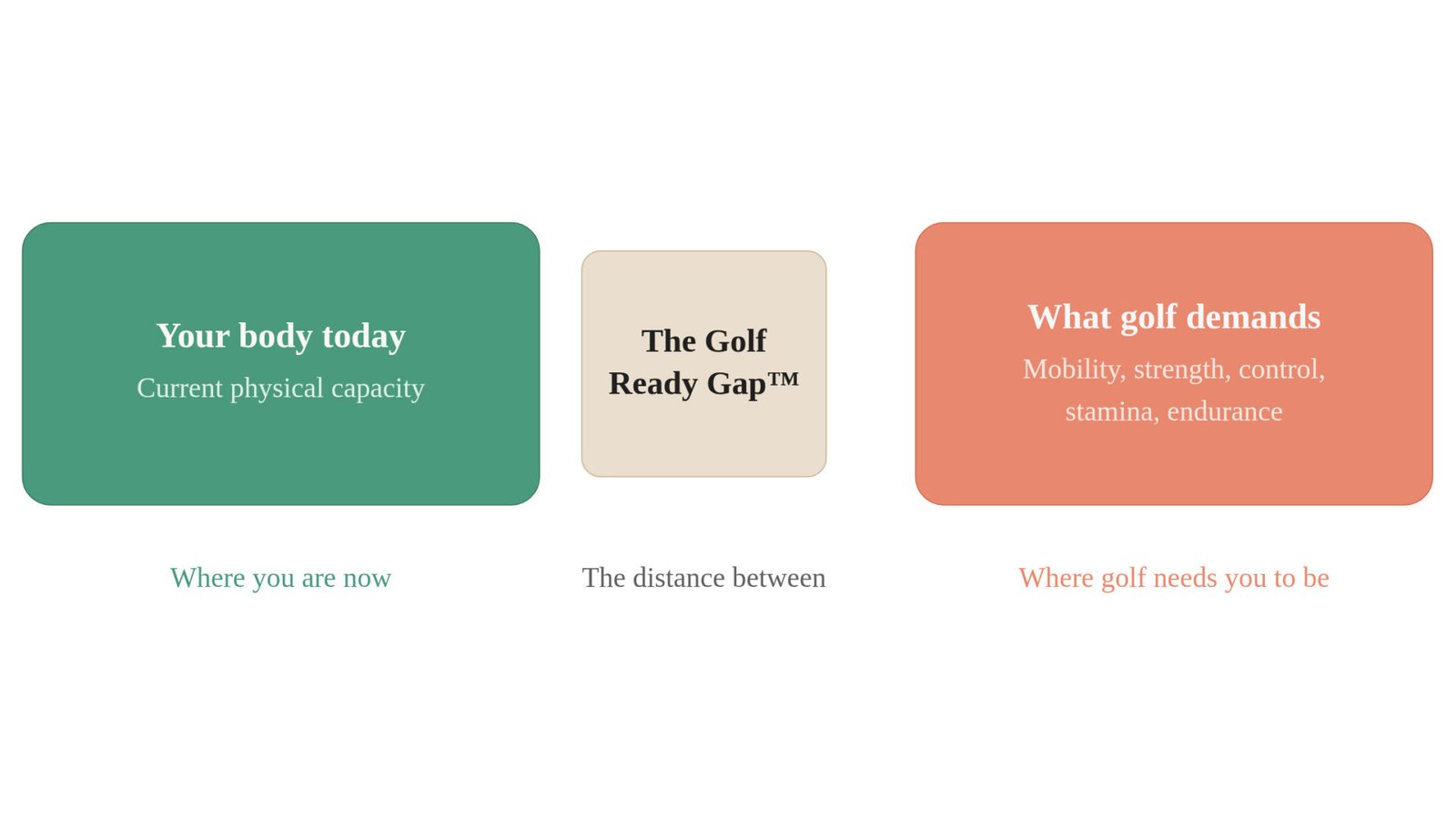
So stop asking “where does it hurt?” Start asking, “Why is that area being overloaded in the first place?” That question is really about your Golf Ready Gap™ – the gap between what your swing needs and what your body can deliver.
7 Signs You Need a Golf Movement Assessment
- Your Back Pain Keeps Coming Back
You’ve stretched, rested, had a massage, taken anti-inflammatories. It settles for a while, then flares up again the moment you play more golf.
That pattern usually points to an underlying movement or loading issue that hasn’t actually been addressed yet.
- Your Back Pain Eases Off Once You’ve Warmed Up
I hear this constantly: “My back hurts for the first few holes, then it eases off.”
It sounds reassuring, but it’s often a capacity issue. Your tissues might tolerate the movement once you’re warm, but whatever’s causing the irritation in the first place is still sitting there.
- One Side Feels Very Different From The Other
Golf is naturally asymmetrical, so some difference is normal. But a big gap between your lead and trail side can create compensations elsewhere.
When the body can’t move efficiently through one area, somewhere else picks up the slack. More often than not, that’s your lower back.
- You’ve Been Given Stretches Before, But Nothing Changes
If you’ve done your mobility work faithfully for weeks or months and nothing’s shifted, it’s worth looking deeper.
It might not be a mobility problem at all. It could be stability, strength, motor control, or how you’re strategising the movement.
- Your Back Pain Gets Worse On The Back Nine
Pain that builds through the back nine often points to reduced physical capacity. Your body’s simply struggling to keep up with four hours of walking, swinging, and carrying or pushing your clubs.
- You Have No Pain In Daily Life
A lot of golfers are surprised that pain only shows up on the course. That usually means it’s not a general medical issue; it’s a golf-specific loading problem.
Golf asks your body for rotation and side-bend in a way that everyday life rarely does.
- You’ve Never Had Your Movement Assessed
Most golfers will spend a fair amount on equipment, lessons, and coaching tech. Very few ever check whether their body can actually get into the positions their coach is asking for.
Without knowing your physical capabilities, it’s hard to say whether the problem’s in the swing, the body, or both – which is exactly the kind of question golf rehab is built to answer.
Quick checklist – do any of these apply to you?
- Back pain that keeps coming back, round after round
- Pain that eases off once you’ve warmed up, then returns
- A noticeable difference between your lead and trail side
- You’ve tried stretching for weeks or months with no real change
- Pain that builds as the round goes on, especially the back nine
- No back pain at all in daily life, only on the course
- You’ve never had your movement properly assessed
If two or more of these sound familiar, stretching alone probably isn’t going to solve it.
Common Mistakes Golfers Make When Trying to Fix Back Pain
Assuming tightness is always the cause. Pain doesn’t automatically mean you’re tight. It’s just as likely to be a strength, control, or load issue.
Stretching the same one or two areas indefinitely. If a mobility routine hasn’t changed anything in a few weeks, doing more of it rarely helps. It’s a sign to look elsewhere.
Ignoring asymmetry. A big difference between your lead and trail side often gets written off as “just golf.” Left unaddressed, it tends to push more load onto the lower back.
Playing through worsening pain without knowing why. Continuing to play isn’t the problem. Doing it blind, without understanding what’s driving the pain, is.
Never increasing playing volume gradually. Jumping from one round a fortnight to three a week is one of the fastest ways to expose an underlying weakness.
Common Causes of Back Pain in Golfers
Back pain is one of the most common golf injury complaints I see, and there’s rarely just one cause. In short: it’s usually some mix of restricted mobility, poor control, low strength, a rapid jump in training load, swing mechanics, and recovery, not one single fault. The combination is usually:
Mobility restrictions – reduced movement through the hips or thoracic spine increases stress on the lumbar spine.
Stability and control deficits – having the mobility is different to being able to control it. Plenty of golfers have good mobility and still can’t use it properly.
Reduced strength – the golf swing generates serious force. If your body can’t absorb and transfer it efficiently, something else takes the strain.
Training load – three rounds a week after a quiet winter is a very different ask to one round a fortnight. Rapid jumps in activity tend to expose weaknesses that were hiding all along.
Swing characteristics – certain patterns put more stress on the lower back, especially combined with physical limitations elsewhere.
Recovery – sleep, nutrition, hydration, stress, and general fitness all affect how well your body copes with golf.
Can You Keep Playing Golf With Back Pain?
Depends on the person. Not all back pain means you need to stop completely.
Plenty of golfers can keep playing while they sort out the underlying issue. But playing through pain that’s getting worse, without knowing why, is a risk.
The goal isn’t just getting through next week’s round. It’s building a body that can handle golf consistently, long term.
What Does a Golf MOT Assessment Look At?
A Golf MOT is built to find out why your body’s struggling to cope with the demands of golf. Rather than just poking at the painful area, we look at the bigger picture:
- Hip mobility and control
- Thoracic rotation
- Balance and single-leg stability
- Lower-body strength and endurance
- Pelvic control
- Rotational movement patterns
- Movement asymmetries
- Golf-specific physical limitations
The aim is to find what’s actually contributing to the problem and build a plan around it.
Simple Next Steps If Your Back Hurts After Golf
- Track when symptoms show up
- Notice whether it improves once you’re warmed up
- Compare how each side of your body moves and feels
- Build up your playing volume gradually rather than jumping straight in
- Add strength and control work alongside any mobility work
- Get a golf-specific assessment if it’s still not shifting
Above all, don’t assume stretching is always the answer.
When Should You Seek Professional Assessment Urgently?
Most of what we’ve covered here is about loading and capacity, not a one-off golf injury. But sometimes back pain is a sign of something more acute. Get checked promptly if you have:
- Significant trauma or injury
- Severe or worsening pain
- Constant pain unrelated to movement
- Unexplained weight loss
- Changes in bladder or bowel function
- Numbness or weakness in both legs
- Anything that’s genuinely worrying you
These symptoms need prompt medical evaluation rather than self-management. If you’re unsure whether your symptoms require urgent assessment, you can read the NICE guideline on low back pain and sciatica (NG59) for further information.
Final Thoughts
Golf back pain is incredibly common. Common doesn’t mean normal.
If you’ve been stretching for months without lasting improvement, stop asking “what stretch should I do?” and start asking “why is my back being overloaded during golf in the first place?”
The answer usually comes from looking at how your body moves, how it controls movement, how it generates force, and how well it tolerates the demands of the game.
A golf swing is only as good as the body producing it. If your back keeps reminding you of that, a Golf MOT might give you answers that stretching never will.
Next step: if any of the 7 signs above sound familiar, the fastest way to find out what’s actually going on is a golf movement assessment. Book a Golf MOT and we’ll find out whether it’s mobility, strength, control, or your swing that’s overloading your back, and build a plan from there.
Frequently Asked Questions:
Why does my back hurt after playing golf?
Golf puts repeated rotational, bending, and loading forces through the spine. Pain can come from mobility restrictions, reduced strength, poor movement control, swing characteristics, or a sudden jump in playing volume.
Is golf bad for lower back pain?
Not necessarily. Plenty of people with lower back pain keep playing successfully. The key is understanding why the pain’s happening and addressing what’s actually causing it.
Should I stretch if my back hurts after golf?
Stretching can help some golfers, particularly where mobility’s genuinely restricted. But on its own it often misses issues around strength, stability, endurance, or movement control.
Can poor hip mobility cause golf back pain?
Yes. Reduced hip mobility can increase the demands on your lumbar spine during the swing, which can contribute to back pain.
Why does my back pain ease off once I warm up in golf?
This usually points to a capacity issue rather than nothing being wrong. Your tissues tolerate the movement better once warm, but the underlying cause, often strength or control rather than tightness, is still there.
Should I stretch or get assessed for golf back pain?
If stretching has already had a fair trial and the pain keeps returning, it’s worth getting assessed rather than stretching further. Assessment identifies the actual driver; stretching only ever addresses one possible piece of it.
What causes back pain during the golf swing?
Most commonly a mix of restricted hip or thoracic rotation, reduced rotational strength, poor pelvic control, or swing characteristics that place extra stress on the lumbar spine.
Why does my back hurt more on the back nine?
This usually reflects reduced physical capacity rather than poor technique alone. Your body can hold things together for a while, then struggles to keep up as fatigue builds over the round.
Is my golf swing causing my lower back pain?
It can be a contributing factor, particularly if your swing relies heavily on your lower back to make up for limited hip or thoracic rotation elsewhere. A movement assessment is the clearest way to find out.
When should I get my back checked for golf pain?
If pain keeps recurring, doesn’t improve with rest or mobility work, or affects how you play, it’s worth getting it assessed sooner rather than later. Seek urgent medical advice for severe, worsening, or unexplained symptoms.
When should I see a golf rehab specialist?
If pain keeps coming back, gets in the way of your enjoyment of golf, limits your performance, or hasn’t shifted despite self-management, it’s worth getting assessed.
Can I still play golf with lower back pain?
Often, yes, while you address the underlying issue, as long as you’re monitoring symptoms and serious causes have been ruled out. If it’s getting worse or affecting daily life, get advice.