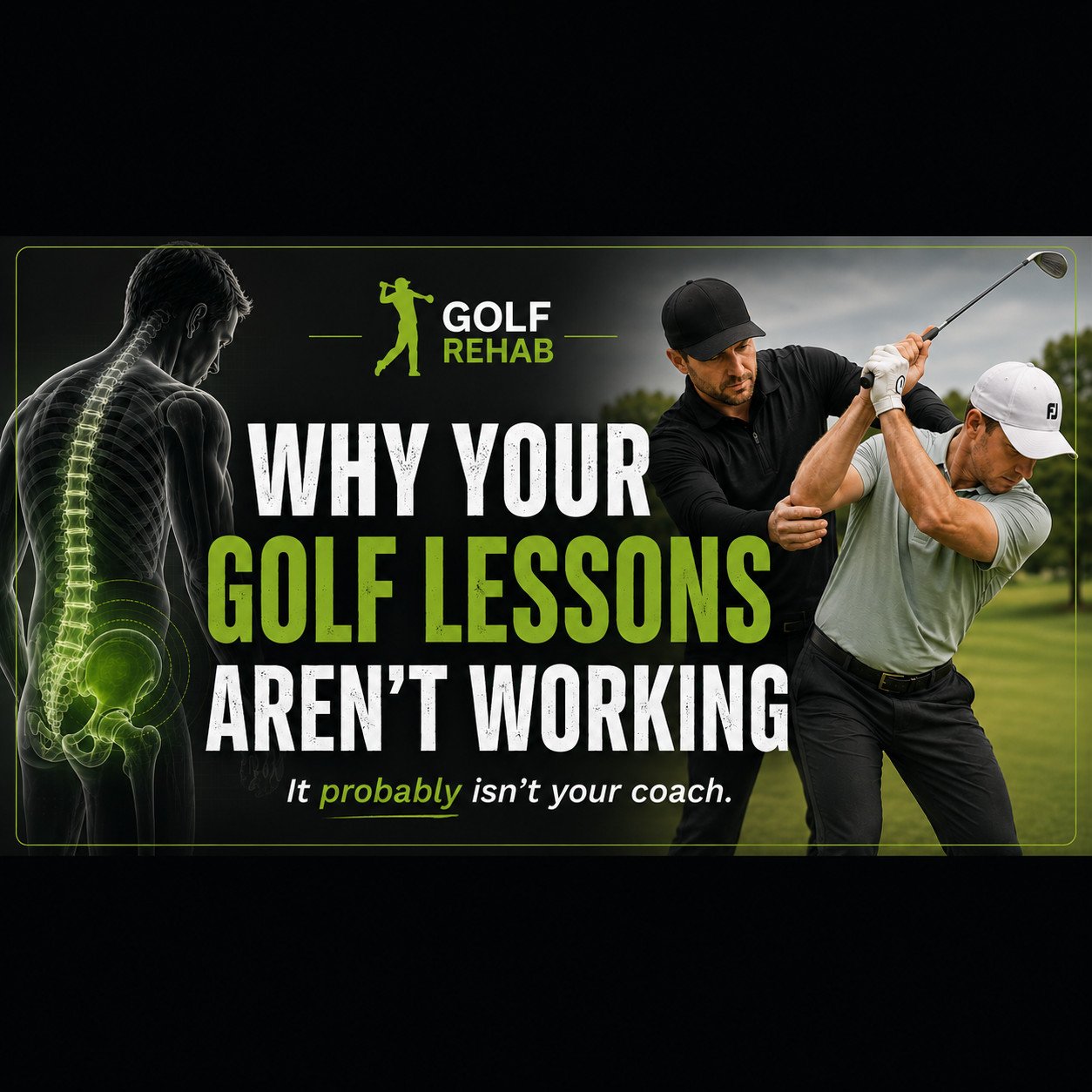
Why your golf lessons aren’t working isn’t always about your technique or your coach. Sometimes the missing piece is whether your body can actually perform the movement you’re trying to create.
You’ve taken more golf lessons.
You’ve watched the YouTube videos.
You’ve bought the driver everyone says fixed their slice.
You’ve put in the hours on the range.
And yet every time you walk onto the course, your old swing turns up anyway.
If that sounds familiar, I want to offer you a different explanation.
Your coach probably isn’t the problem.
In fact, they’re likely giving you exactly the right advice.
The missing piece is often much simpler: your body isn’t yet capable of making the movement your coach is asking for consistently.
Why Your Golf Lessons Aren’t Working
Golf lessons don’t always produce lasting improvement because golf is about far more than technique. The golf swing places significant demands on your mobility, stability, strength, balance and coordination. If your body can’t meet those demands, even the best coaching can become difficult to apply consistently.
That’s why so many golfers leave a lesson feeling fantastic, only to find those improvements disappear on the course.
When progress stalls, golfers usually blame one of four things.
- I need another lesson.
- I need more practice.
- Maybe I need a different coach.
- Maybe I’m just not good enough.
Sometimes those thoughts are completely understandable.
But there’s another possibility that very few golfers ever consider. It’s the one I see most often in clinic.
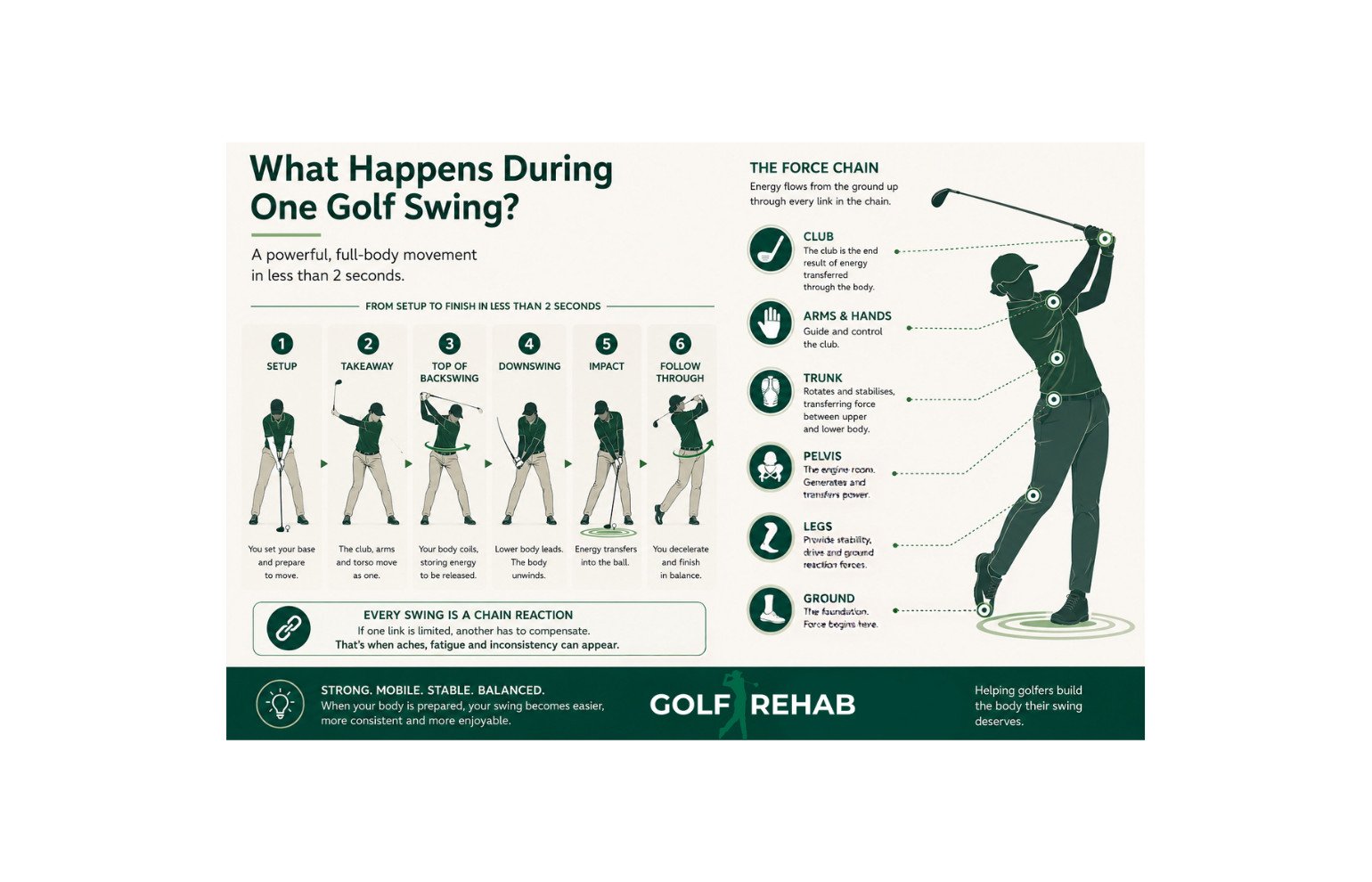
Your golf swing is a physical movement.
If your body isn’t yet capable of making the movement your coach is asking for, it’ll instinctively find another way to get the club to the ball.
That’s compensation.
And it’s one of the biggest reasons golf lessons don’t always stick.
Can Body Mobility Affect My Golf Swing?
Imagine asking someone to throw a ball overarm after they’ve lost half of their shoulder rotation.
No amount of coaching changes the fact that the movement simply isn’t available.
They’ll throw differently every single time because that’s the only movement their body can produce.
Golf works exactly the same way.
If your hips won’t rotate…
If your upper back is stiff…
If your balance isn’t good enough…
If you can’t create force through one leg…
… your swing has no choice but to adapt. Your body will always find a way to get the club to the ball. It just might not be the way your coach intended.
Why Do I Keep Getting The Same Swing Fault?
This is something I hear constantly.
“I fix it on the range, then it comes straight back on the course.”
Usually that’s because the fault was never purely technical.
It was your body returning to the same movement pattern because that’s the one it has the capacity to repeat.
During a Golf MOT assessment, I often say something that sums this up perfectly.
Your swing can only express what your body allows.
Golf instruction works with movement.
Your body creates movement.
If it lacks the movement options your swing depends on, it’ll compensate somewhere.
That’s why some golfers seem to lose their swing after six holes.
It usually isn’t their technique breaking down.
It’s their body returning to the movement pattern it has the capacity to repeat.
You can’t coach a movement the body can’t yet perform.
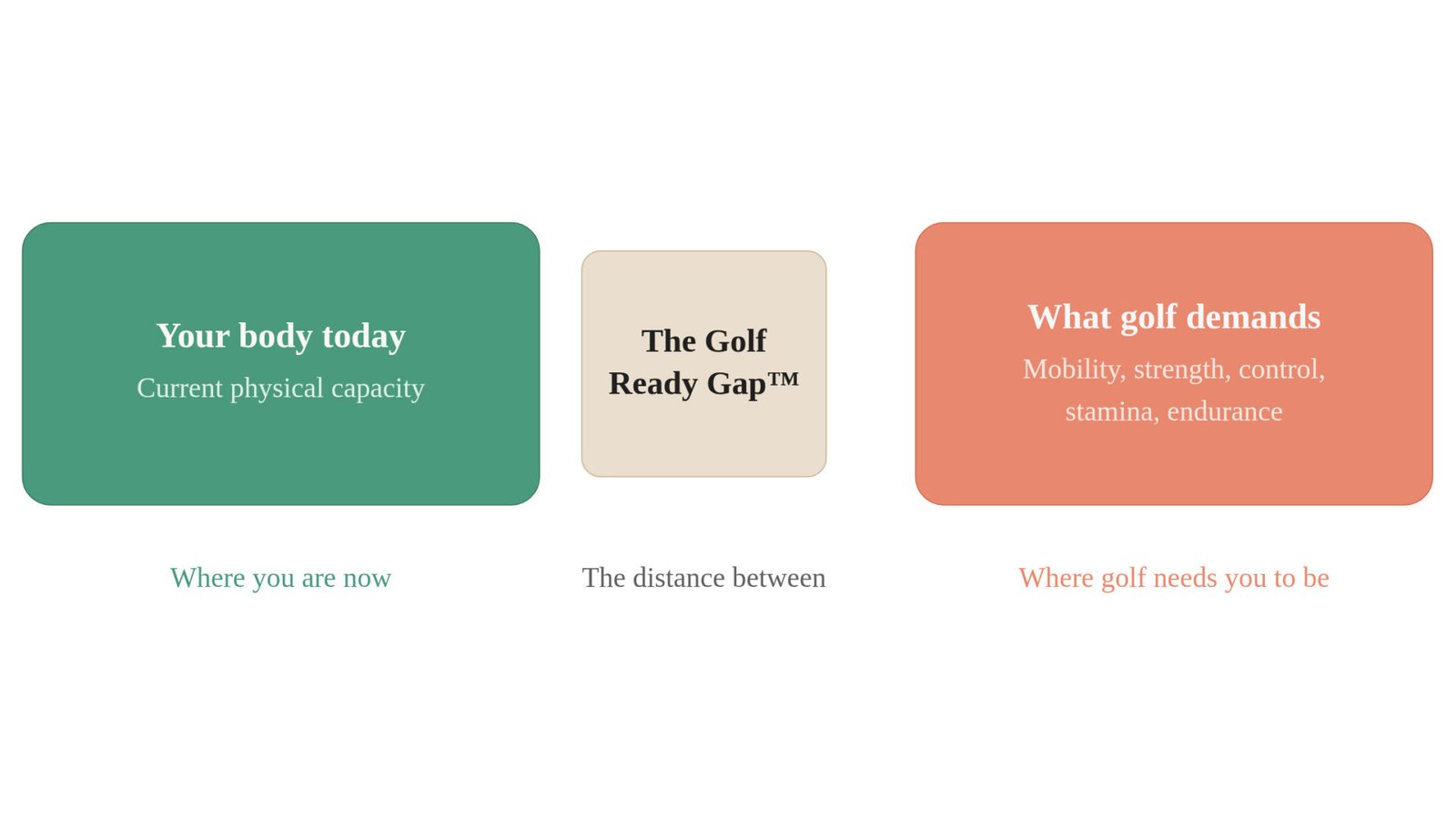
What Is The Golf Ready Gap?
This is what I call the Golf Ready Gap.
The Golf Ready Gap is the difference between what your golf swing demands and what your body can currently deliver.
That gap can exist whether you’re:
- New to golf.
- A single-figure handicap golfer.
- Returning from injury.
- Completely pain free.
Two golfers can have identical swings on video.
One repeats it for eighteen holes without a problem.
The other falls apart after six.
The difference is often physical capacity.
Five Signs Your Body May Be Limiting Your Golf Swing
Your body could be limiting your progress if:
- Your coach keeps asking you to work on the same swing change.
- Your swing feels great on the range but disappears on the course.
- You lose your swing after a few holes.
- You regularly feel stiff or restricted during a round.
- You find yourself having to “find your swing” every time you play.
If two or three of those sound familiar, there’s a good chance your body is limiting the changes you’re trying to make.
How Do I Know If My Body Is Limiting My Golf Swing?
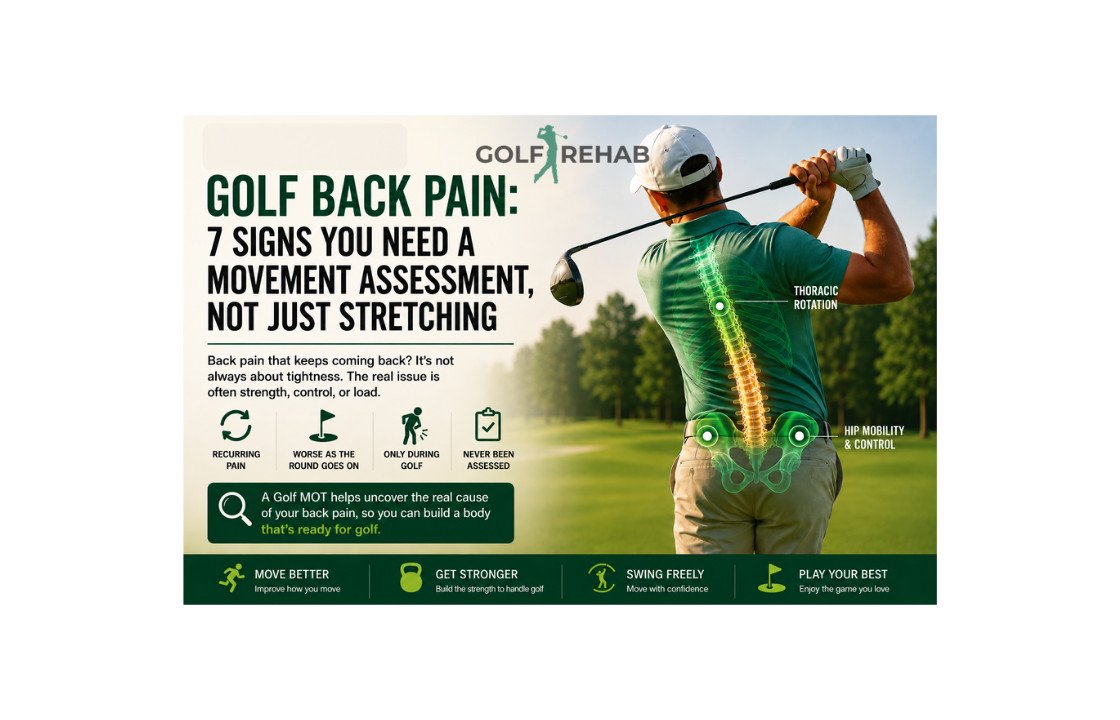
During a Golf MOT assessment, I regularly find golfers who’ve never realised they’re dealing with:
- Limited hip rotation, making it harder to rotate efficiently through impact.
- Reduced upper back mobility, causing the body to compensate elsewhere.
- Poor balance, making consistent ball striking much more difficult.
- Reduced lower-body strength, limiting the force they can create.
- Poor pelvic control, affecting how efficiently the body sequences throughout the swing.
None of these automatically causes poor golf.
But stack a few together and even excellent coaching becomes very difficult to put into practice consistently.
Should I Improve Mobility Before Changing My Swing?
Often, yes.
If you’re trying to make a swing change your body simply can’t access yet, you’ll spend weeks trying to force a position that isn’t available.
Improving the mobility or strength needed to make that movement possible often gets you there much faster than technique work alone.
Can Strength Improve Golf Performance?
Absolutely.
When golfers hear the word strength, many imagine bodybuilding or lifting heavy weights.
In reality, golf-specific strength is about producing force, controlling movement and staying stable enough to repeat your swing from the first tee to the eighteenth green.
Many golfers spend thousands on equipment before they’ve ever tested whether their body is physically capable of producing the force their swing demands.
Why Practice Sometimes Makes Things Worse
Practice is essential.
But if you repeatedly practise a movement your body can’t produce efficiently, you often become better at performing the compensation rather than the movement your coach intended.
That’s why you can feel brilliant on the lesson tee but completely lose it during a medal round.
Nothing technical has changed.
Your body has simply returned to the movement pattern it trusts most.
A Quick Word To Golf Coaches
If you’re a golf coach reading this, you’ve probably experienced something similar yourself.
Some golfers understand exactly what you’re asking almost immediately. They make the change, repeat it consistently and improve quickly.
Others hear exactly the same instruction but never quite seem able to produce the movement, no matter how many different ways you explain it.
That doesn’t necessarily mean your coaching isn’t working.
Sometimes it simply means the golfer’s body doesn’t yet have the movement capacity needed to perform that movement consistently.
One of the reasons I enjoy working with golf coaches is that our roles naturally complement one another.
You understand the swing changes you’re trying to achieve.
My role is to identify whether the golfer’s body has the physical capacity to support those changes and, where it doesn’t, help them develop it.
You coach the swing.
I help golfers build the body that can support it.
When we work together, golfers often make technical changes more quickly because their body is better able to respond to your coaching.
If you’re interested in offering Golf MOT assessments, golfer movement screening or educational workshops at your club or academy, I’d be delighted to have a conversation about how we could work together to help your golfers get more from your coaching.
Do I Need A Golf Movement Assessment?
Before booking another golf lesson, ask yourself three simple questions.
- Can my body actually make the movement I’m trying to learn?
- Has the physical side of my game ever been properly assessed?
- Am I practising a compensation rather than a solution?
If you can’t answer those with confidence, a golf movement assessment may tell you more in an hour than another month of golf lessons.
Final Thoughts
Your coach teaches the movement.
Your body has to deliver it.
When those two things work together, progress becomes much easier.
When they don’t, you can end up trapped in a cycle of lessons, practice and frustration that never quite resolves.
Understanding your physical starting point doesn’t replace coaching.
It simply gives your coach a body that’s better able to do what they’re asking.
What To Do Next
If you’ve been working hard on your swing without seeing lasting progress, it might be time to look beyond technique.
Not sure where to start?
The Golf Ready Baseline Check is a free online questionnaire that helps you discover whether you’ve ever measured the physical side of your golf game.
Or
Book a Golf MOT assessment and we’ll identify the movement, strength and control your swing depends on, show you where your Golf Ready Gap exists, and build a plan to help you close it.
Because great coaching deserves a body that’s capable of responding to it.