Most golfers assume their biggest limitation is their golf swing.
So they book another lesson. Watch another YouTube video. Buy another training aid. Spend another afternoon on the range trying to fix what feels broken.
Yet despite all that effort, golf swing changes don’t stick. The same faults keep returning. The body feels stiff halfway through the round. The back tightens. The hips stop rotating. The power disappears.
And the frustrating part? Most golfers assume they simply need more practice.
But what if the real problem isn’t your swing at all?
What if your body simply isn’t prepared for what the golf swing demands?
Why Your Golf Swing Feels Like It’s Letting You Down
Most golfers spend years searching for the answer in their technique. A better hip turn. A cleaner takeaway. More lag. Less spin.
But technique can only take you so far when the body producing the swing isn’t physically prepared to support it.
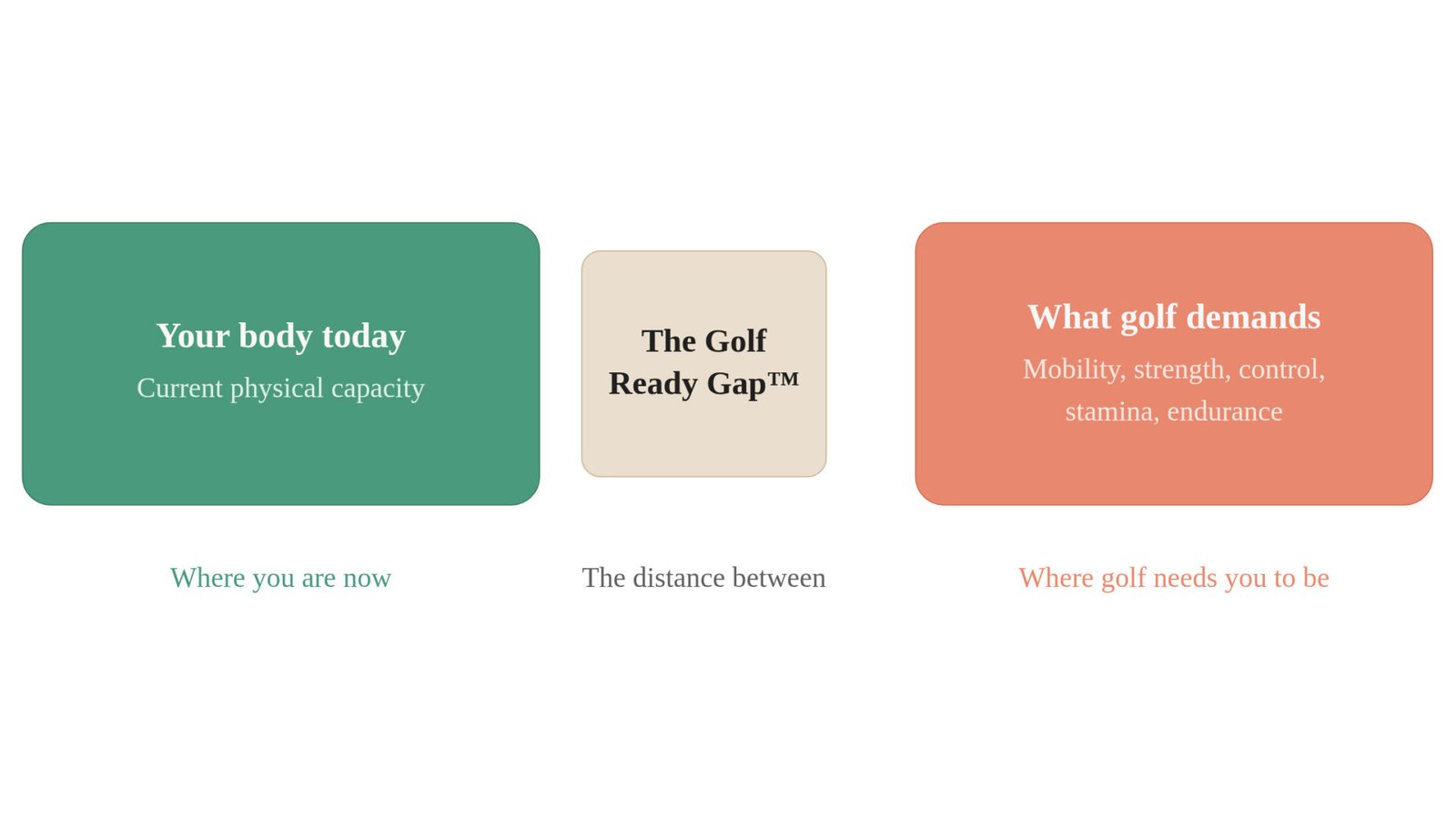
That’s where The Golf Ready Gap™ comes in.
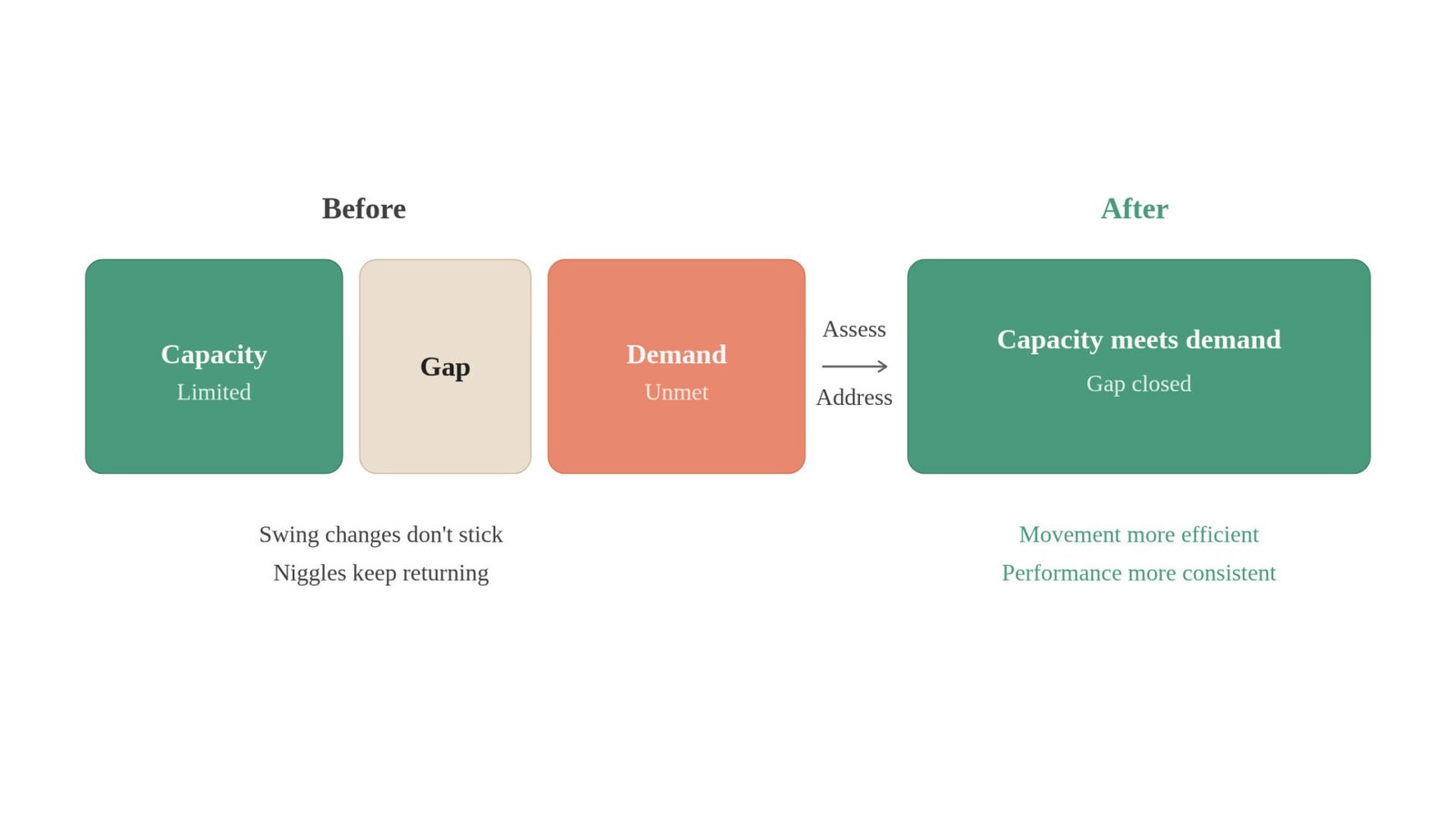
The Golf Ready Gap™ is the distance between your body’s current physical capacity and what the golf swing actually demands.
It doesn’t matter whether you’re returning from injury, have just finished treatment, or have never been injured at all. If your body lacks the mobility, strength, control or stamina that golf requires, the gap exists.
The bigger that gap becomes, the harder it is to swing efficiently, perform consistently, and tolerate the demands of playing and practising golf.
What Golf Actually Demands From Your Body
Golf looks easy. From the outside it appears to be a gentle sport involving a short walk and a few swings of a club.
The reality is very different.
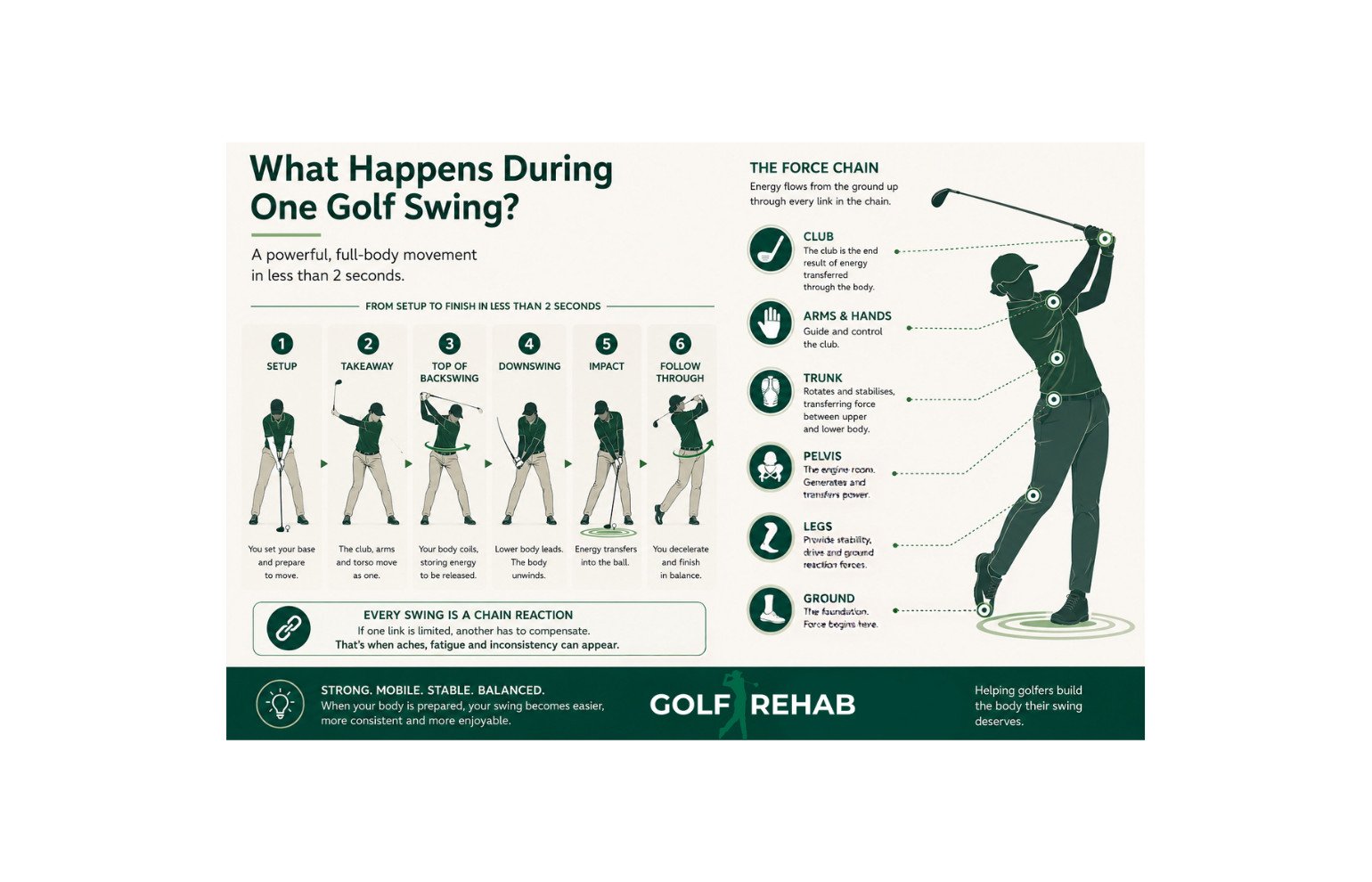
A typical round involves over 50 full-speed, loaded, whole-body rotations. Each one requires your body to produce power, control movement and absorb force. Not once, but repeatedly, across several hours. Research published in the British Journal of Sports Medicine found that more than half of amateur golfers experience a musculoskeletal injury during their golfing lifetime — a figure that highlights just how significant the physical demands of the game actually are.
To meet those demands efficiently, your body needs adequate mobility through the hips, thoracic spine and shoulders, stability through the feet, knees, pelvis and trunk, enough strength to create and control force, the balance to transfer weight effectively, and the endurance to repeat those movements across an entire round.
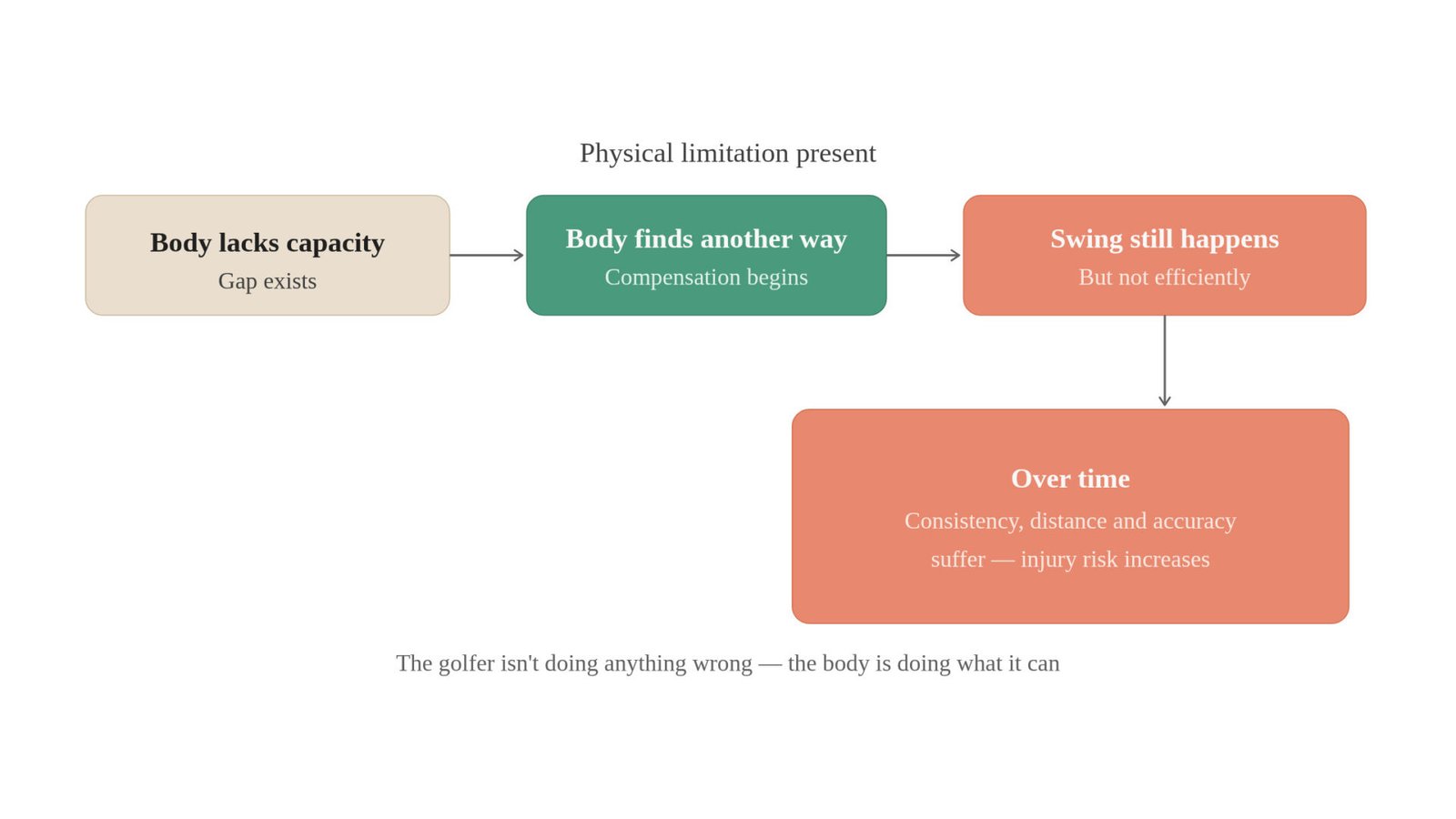
When one or more of those qualities are lacking, the body finds another way to get the job done.
That’s when compensations begin.
The Compensation Trap
The body is remarkably good at finding a way to complete the task. The problem is that the solution isn’t always efficient.
A golfer who lacks hip rotation may still complete a backswing by rotating excessively through the lower back. A golfer who lacks stability through the lead leg may lose power during the downswing. Someone with plenty of passive movement available may simply lack the strength or control to use it effectively when the club is moving at speed.
The golfer still swings. The ball still gets hit. But the movement becomes less efficient, and over time that inefficiency shows up in consistency, distance, accuracy, energy levels and injury risk. Research into musculoskeletal complaints in golfers has identified suboptimal swing biomechanics and repetitive practice volume as primary underlying causes of golf injury – both of which are directly influenced by the physical capacity the golfer brings to the game.
The body is adapting to its limitations rather than working from a place of genuine physical readiness.
Why Golf Swing Changes Don’t Stick
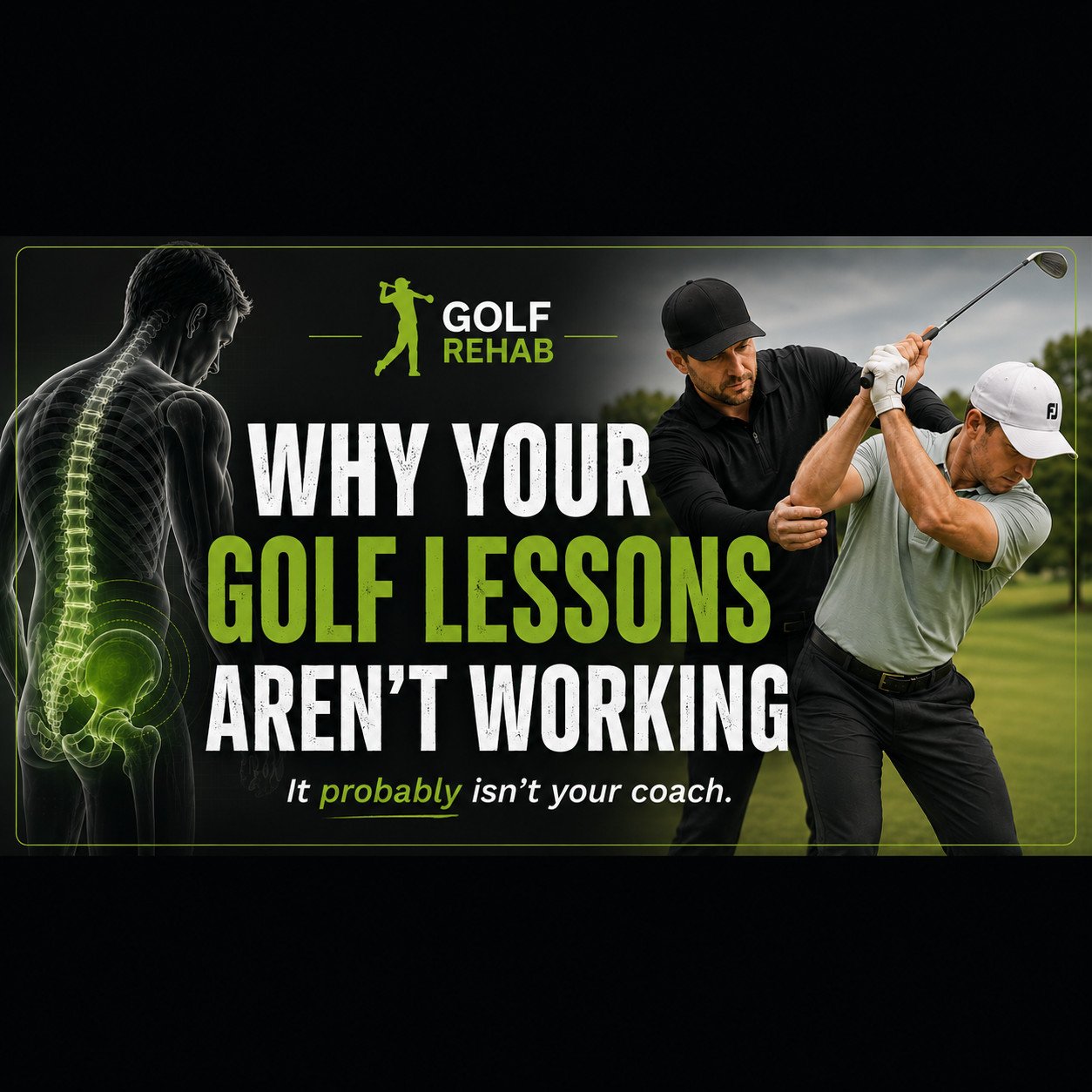
This is where many golfers become frustrated. They’ve had the lesson, understood the correction, done the practice – yet golf swing changes don’t stick.
A coach identifies a fault. The golfer understands the correction and can even demonstrate it during the lesson. Yet a week later they’ve reverted to the old pattern.
Why?
Because the body may not currently have the physical capacity to support the change. The golfer isn’t being stubborn or failing to listen. Their body is simply defaulting to the movement pattern it can currently tolerate.
This is often where the gap becomes most visible. The technical solution exists. The physical foundation doesn’t. And until that changes, golf swing changes don’t stick – regardless of how much time you spend on the range.
You Don’t Have To Be Injured To Have A Gap
One of the biggest misconceptions in golf is that physical preparation only matters when something hurts.
In reality, the gap can exist long before pain appears. A golfer may be playing every week, scoring reasonably well and completely pain-free, yet still operating below their potential because their body lacks what the swing actually demands.
Pain isn’t always the first warning sign. Sometimes it’s reduced distance, declining consistency, slower recovery between rounds, or just a persistent feeling of restriction that never quite goes away.
The Goal Isn’t Perfection
No golfer has a perfect body. And no golfer needs one.
The goal isn’t to become the most mobile, strongest or fittest person on the course. It’s simply to have enough physical capacity to meet the demands of your game. To be physically prepared for what you’re asking your body to do.
To be golf ready.
How Do You Know If You Have A Golf Ready Gap?
Most golfers know their handicap, their club distances, how many fairways they hit. Very few have ever assessed their physical baseline.
Can you rotate effectively through your hips? Can you transfer weight efficiently? Can you control movement on one leg? Can you create and absorb force? Can your body tolerate the volume of golf you want to play?
Sometimes the gap only becomes obvious as fatigue builds. If your movement or ball striking regularly becomes less reliable later in the round, read Why Your Golf Swing Gets Worse When You’re Tired to understand what may be changing on the back nine.
Without that picture, it’s impossible to know whether a gap exists, let alone where it is or how to close it.
Closing The Gap
Every golfer has a swing. Every golfer has a body. The two are completely connected, yet most golfers spend years working on one while giving very little attention to the other.
At Golf Rehab, we believe better golf starts with understanding your body first.
When your physical capacity matches the demands of your swing, things get easier. Movement becomes more efficient. Golf swing changes become easier to make and easier to keep. And your body becomes more capable of handling the game you love.
The gap gets smaller.
Final Thought
Before you invest in another lesson, another training aid or another swing tip, ask yourself one simple question.
Is my body actually prepared for the demands I’m placing on it?
Because the biggest thing holding your golf back might not be your swing at all.
It might be the gap.
Think you might have a Golf Ready Gap™?
Most golfers do, and most have never had it properly assessed.
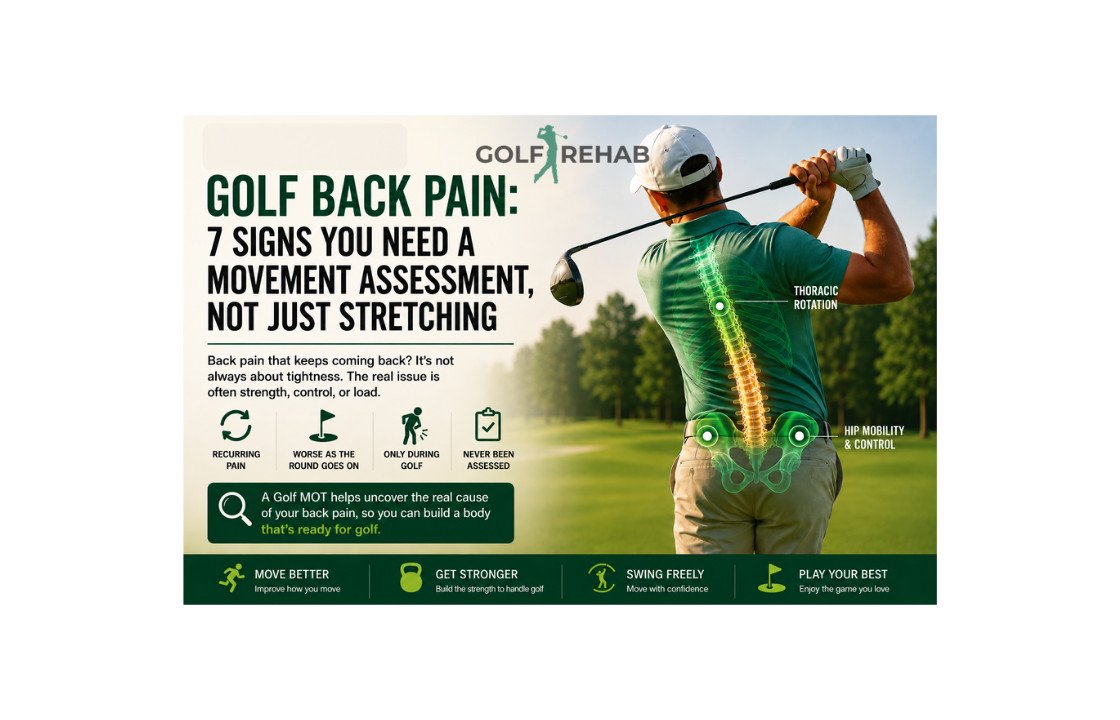
The Golf MOT is a full physical assessment designed specifically for golfers, built to identify exactly where your body is limiting your game.