Most golfers have been there.
You watch a lesson online. Your coach shows you a movement. You see a tour player make a beautiful swing, and you think: “That’s what I need to do.”
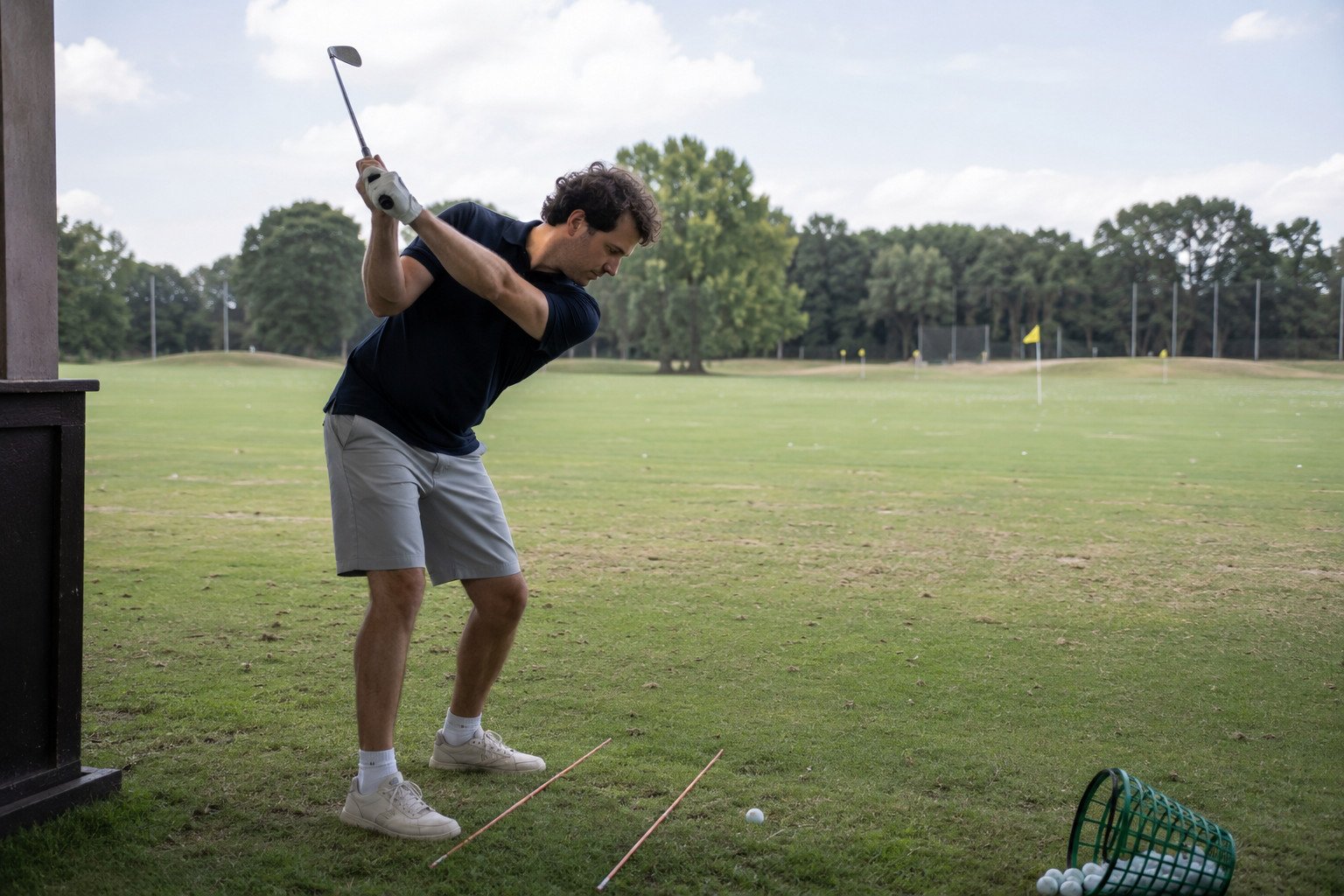
So you head to the range and start working on it. You focus on the positions, rehearse the movement, try to make your swing look more like the one you’ve been shown.
Yet somehow it never quite feels right. The movement feels forced. This is exactly why golf swing changes don’t stick for so many players. Or perhaps it works for ten balls before disappearing again.
At that point, most golfers assume they need more practice. But what if that’s not the real issue? What if your body simply can’t create the movement you’re asking it to perform?
If you read last week’s piece on The Golf Ready Gap™, you’ll know where this is going.
The Swing You Want vs The Body You Have
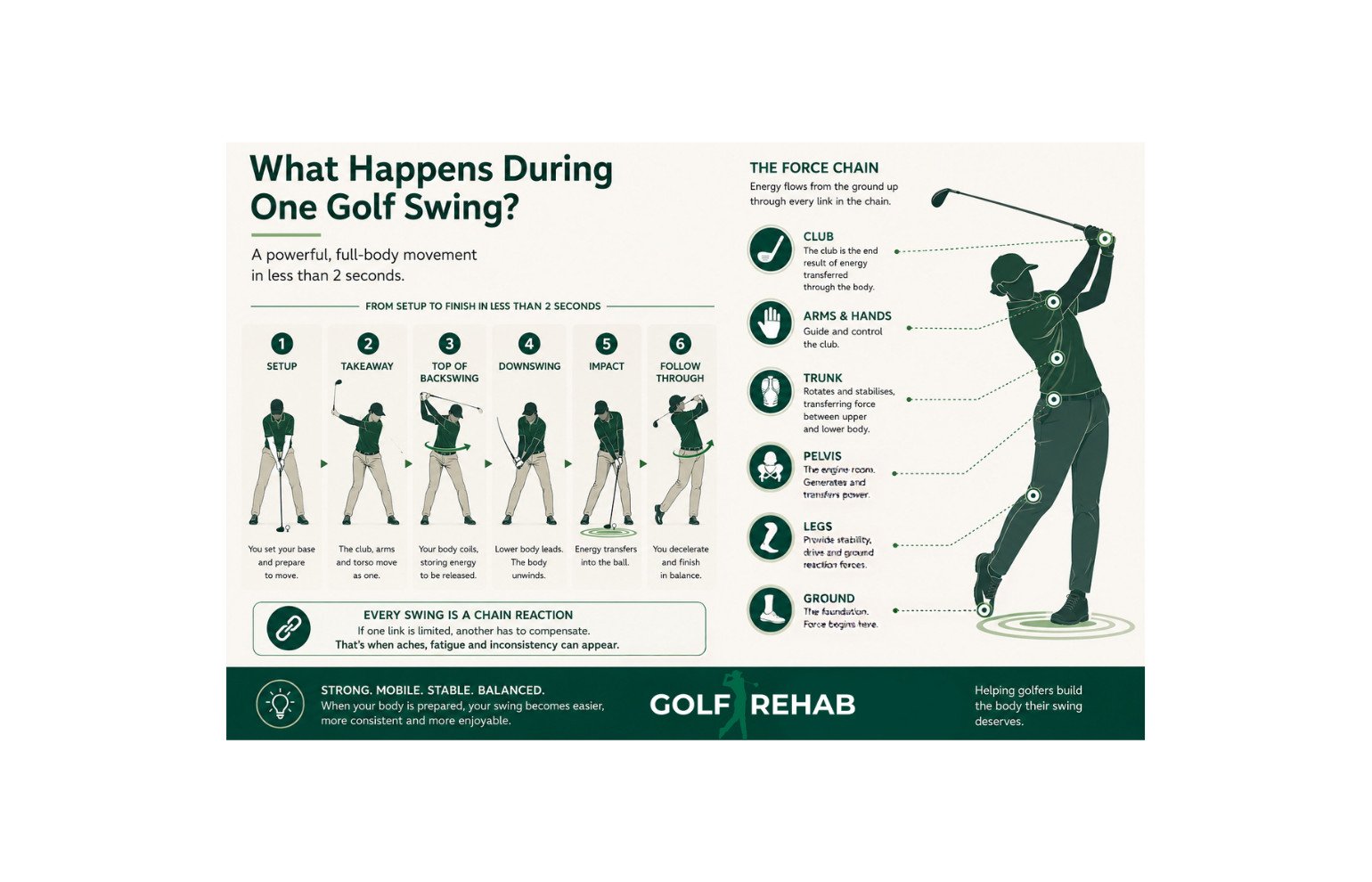
Golfers are constantly given technical advice. Turn more. Rotate better. Stay in posture. Shift your weight. Create separation. Finish your swing.
All perfectly reasonable instructions. The problem is that every one of those movements requires certain physical abilities — mobility, stability, strength, balance, coordination, control.
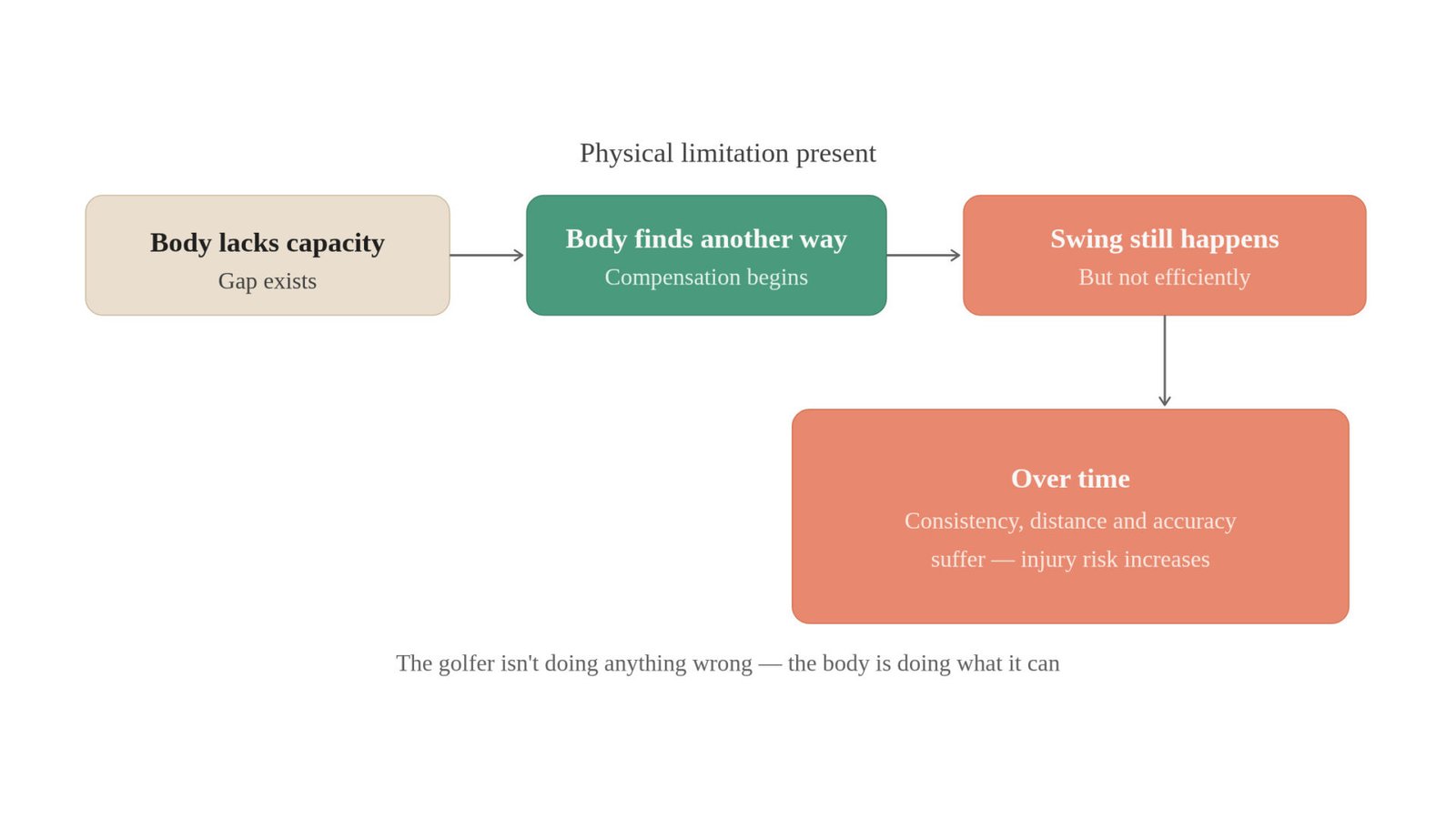
Without those ingredients, the body has to find another way. That’s when compensations appear. Not because you’re a bad golfer. Not because you’re not trying hard enough. But because the body will always find a way to complete the task, even if it isn’t the most efficient way.
A Simple Example
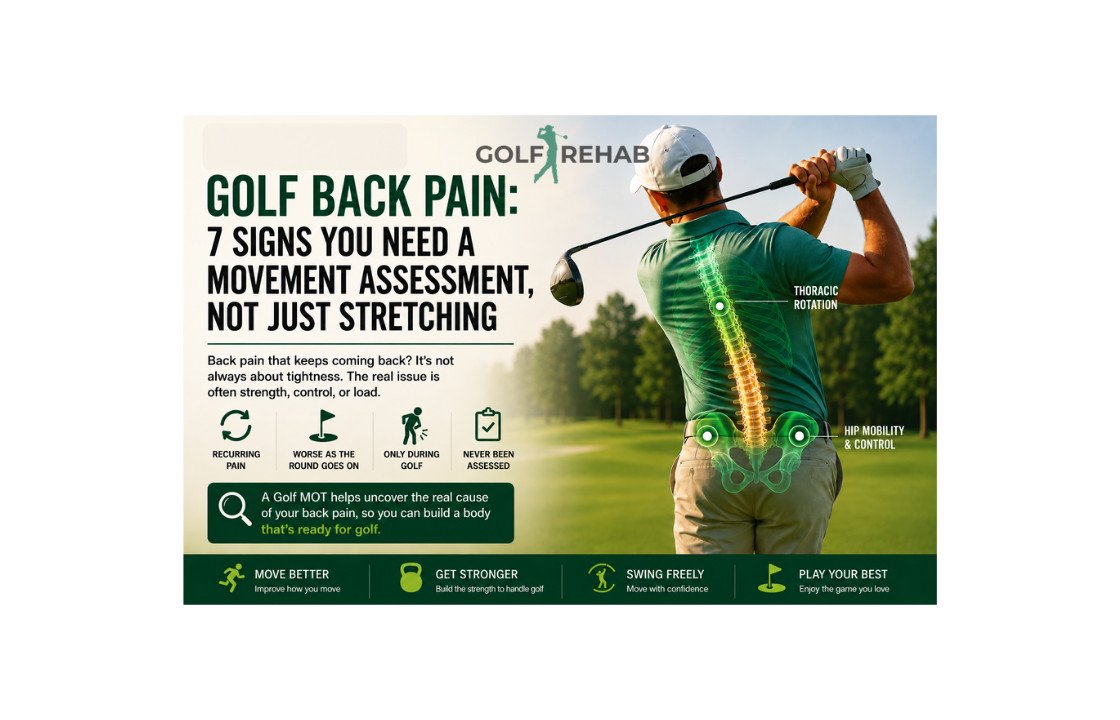
Imagine a golfer is told to create a bigger shoulder turn. Sounds straightforward. But what if they have limited thoracic rotation? What if their hips don’t rotate well, or they struggle to separate upper and lower body movement?
The golfer still needs to get the club to the top of the backswing. So the body improvises. Perhaps the lower back rotates more. Perhaps posture changes, or balance shifts, or the lead knee collapses inward.
The swing still happens. But it happens differently. The body finds a solution — and unfortunately, that solution isn’t always the most effective one. Over time it may contribute to discomfort, inconsistency, reduced power, or simply make the game harder than it needs to be.
Even Good Golfers Have A Golf Ready Gap™
Recently, I assessed a golfer who plays off a plus handicap. No significant injury history. No pain while playing. Most people would assume there wouldn’t be much to find. To be honest, I thought the same.
Yet one thing stood out almost immediately. He had the movement available to rotate through his hips — the range of motion was there. But when we looked at how he controlled and coordinated that movement, things became more interesting.
In certain positions, he struggled to use the movement consistently. A few simple cues improved it almost immediately.
That told us something important. The movement was available. The challenge was accessing and controlling it effectively. And that raises an interesting question: if a golfer has access to movement but isn’t consistently using it, what happens when swing speed increases, fatigue builds, or pressure rises?
That’s exactly the type of question a baseline assessment helps answer. Not because we’re looking for problems, but because we’re trying to understand whether the body is supporting performance as effectively as it could.
Why Golf Swing Changes Don’t Stick
This is something I see regularly. A golfer receives excellent coaching. The advice is correct. The movement they’re trying to achieve is exactly what they need.
Yet a few weeks later they’re back where they started. Not because the lesson was wrong. Not because they didn’t practise. But because the physical capacity and mobility required to support the change wasn’t there. Or perhaps the movement was available, but they lacked the control, coordination or strength to use it consistently.
Imagine trying to build a house on soft foundations. You can keep improving the structure above, but eventually the foundations become the limiting factor. The golf swing works in much the same way. If the body cannot support the movement, the movement often disappears under pressure, fatigue or repetition.
The Body Doesn’t Care About Perfect Positions
One of the biggest misconceptions in golf is that everyone should swing the club the same way. In reality, golfers come in all shapes and sizes — different injury histories, different ages, different mobility profiles, different strengths and weaknesses.
The goal isn’t to force everyone into identical positions. The goal is to understand what their body can currently do, and whether that matches what the swing requires.
Sometimes the answer is yes. Sometimes the answer is no. And when the answer is no, the conversation becomes far more interesting. Because now we’re not asking “How do we fix the swing?” We’re asking “Why does this swing fault keep showing up under golf-specific load and speed?”
That’s often where the real answers are found.
The Question Most Golfers Never Ask
Most golfers know their handicap. Many know their clubhead speed. Some know their carry distances.
Very few know their physical baseline.
What Physical Factors Affect Your Golf Swing?
Can you rotate through your thoracic spine effectively? Can you control pelvic movement independently? Can you balance on one leg? Can you produce and repeat force throughout an entire round?
Research backs this up. A 2021 study of competitive golfers found that movement screening results were directly linked to key swing mechanics, including thoracic and pelvic rotation during the swing.
Most golfers have never tested any of those things. Yet those factors may be influencing every swing they make.
The Golf Ready Gap™
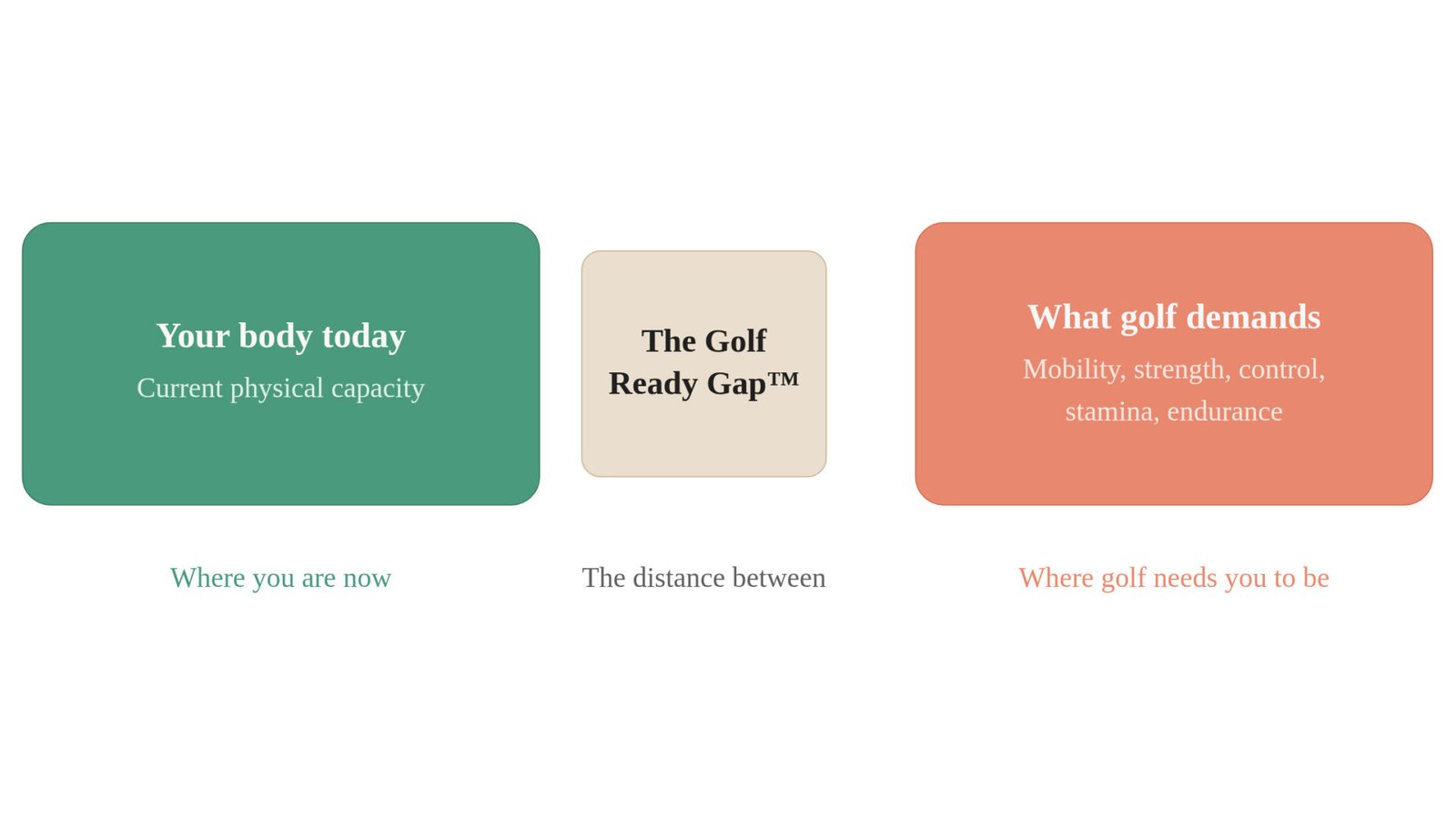
This is exactly where The Golf Ready Gap™ comes from. It’s the difference between what your golf swing requires and what your body is currently capable of supporting.
Sometimes that gap is mobility. Sometimes it’s strength, or balance, or control — and sometimes it’s a combination of several factors working together.
The bigger that gap becomes, the harder golf often feels. Not necessarily because your technique is poor, but because your body is working harder to find alternative ways to produce the movement. The smaller that gap becomes, the easier it is for good movement patterns to emerge and repeat.
Final Thoughts
The next time you’re working on a swing change, ask yourself a different question. Not “Am I doing the movement correctly?” but “Does my body currently have the capacity and control to perform this movement consistently?”
Because sometimes the issue isn’t the instruction. It isn’t the coach. It isn’t even the swing. Sometimes the missing piece is simply making sure the body is prepared for the task you’re asking it to perform.
And until you know that, you’re only seeing part of the picture.
What About Your Swing?
That’s one of the reasons we start with a baseline assessment rather than guessing. Before trying to change a swing, it makes sense to understand what your body can currently support.
Because when you know where your Golf Ready Gap™ exists, you can start working on the factors that may be making golf harder than it needs to be. And that’s exactly what we look at during a Golf MOT.