
If watching the AIG Women’s Open makes you want to play more golf, return after time away or finally give the game a try, that can only be positive for women’s golf.
The 2026 Championship is the 50th staging of the AIG Women’s Open and is being played at Royal Lytham & St Annes. As the world’s best female golfers compete across one of England’s most demanding links courses, we see the accuracy, control and power that make elite golf so impressive.
What we do not always see is how physically demanding that level of golf can be.
Golf is often described as a low-impact sport. In many ways, it is. It does not involve the collisions of rugby or the constant running of football. But the golf swing is still a fast, powerful movement that places repeated demands on the lower back, hips, neck, shoulders, elbows, wrists and hands.
That does not make golf dangerous. The goal isn’t to make you worry about golf. It’s to help you enjoy the game for longer, with greater confidence in what your body can do.
It means the body needs to be prepared for the golf we ask it to play.
Recent research into elite professional women’s golf found that aches, pains and physical complaints were surprisingly common. It also highlighted something that has received far too little attention: women golfers may experience different injury patterns depending on whether they play professionally, compete at club level or are just beginning.
In This Article
- Why the swing isn’t the biggest lesson
- The hidden physical demands of the golf swing
- Why copying a tour player rarely works
- The Golf Ready Gap explained
- Four myths that hold golfers back
- What to watch during the AIG Women’s Open
- Frequently asked questions
We All See the Swing. We Rarely See What Makes It Possible.
Watch the players carefully this week.
Yes, you’ll see beautiful golf swings.
But look beyond the club.
Watch how balanced they are.
Notice how athletic they move.
Watch how they stay in control from the start of the swing to the finish.
Look at how comfortably they rotate through the ball and hold their finish without losing balance.
What you’re seeing isn’t just technical skill.
You’re seeing bodies that have been developed to cope with the demands of elite golf.
That’s an important distinction.
The golf swing isn’t happening in isolation.
It’s being produced by a body capable of generating force, controlling movement, absorbing load and repeating that process hundreds of times every week.
That’s something many amateur golfers never consider.
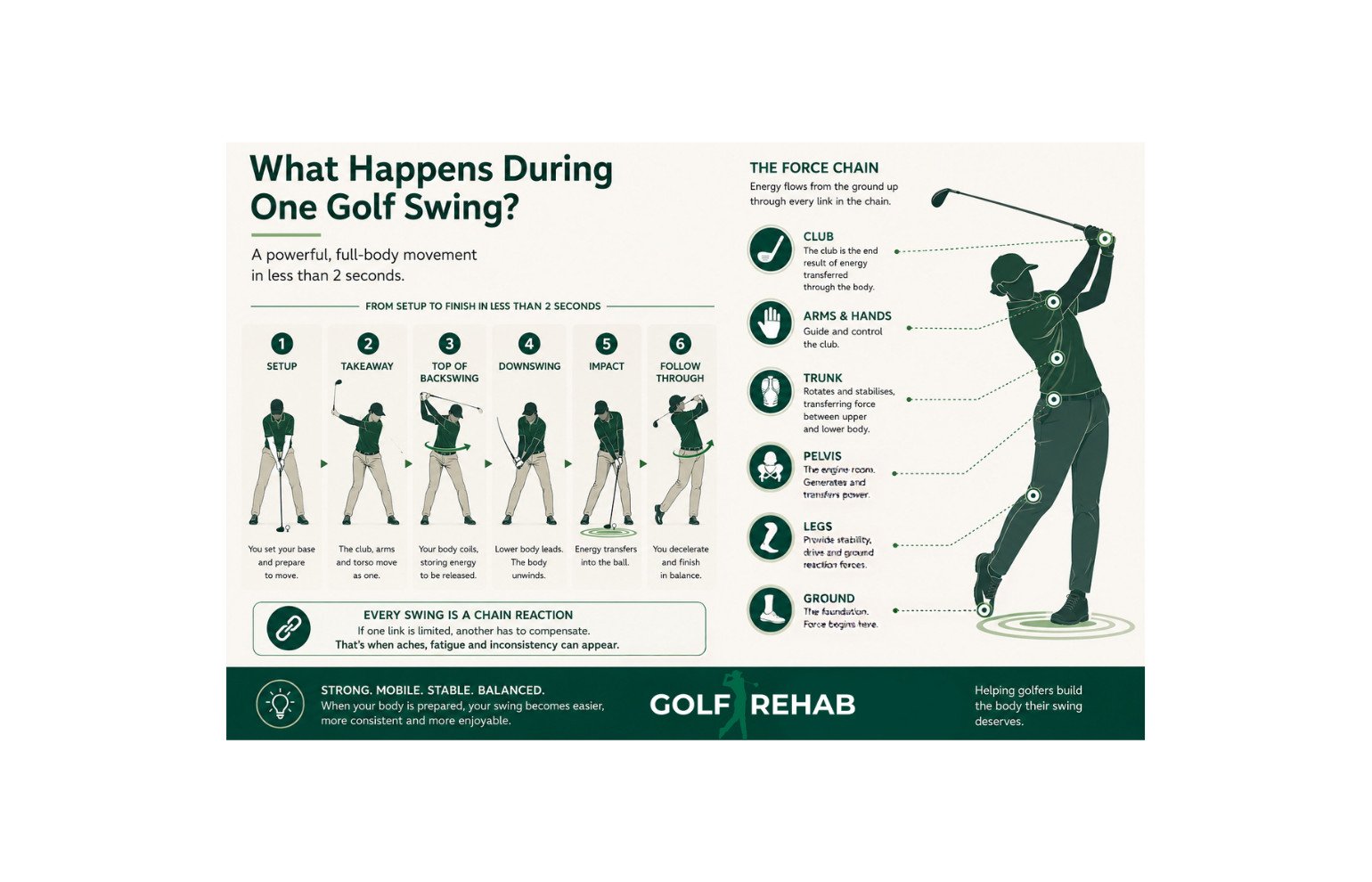
The Golf Swing Is More Physical Than Most People Realise
It’s easy to think of golf as a technical sport.
In reality, it’s an incredibly demanding physical movement.
During every swing your body has to:
- Rotate efficiently through your hips and thoracic spine.
- Transfer force from the ground through your legs, pelvis and trunk.
- Maintain balance while moving at speed.
- Control the club through impact.
- Decelerate safely after the ball has gone.
All of this happens in less than two seconds.
If one part of that system can’t do its job, another area has to compensate.
Perhaps your hips don’t rotate as well as they used to.
Maybe your thoracic spine has become stiff after years of desk work.
Perhaps you’ve lost some strength or confidence after an old injury.
Your brain is remarkably good at finding another way to complete the movement.
The problem is that compensation often works….until it doesn’t.
Sometimes it simply costs you consistency.
Sometimes it reduces distance.
Sometimes it leaves your back, hips, knees or shoulders taking more load than they were designed to handle.
Why Copying a Tour Player Rarely Works
One of the most common things I hear is:
“I saw a video online and tried changing my swing.”
Sometimes it helps.
Often it doesn’t.
Not because the advice is wrong.
But because your body may not currently be capable of reproducing that movement.
Imagine asking two golfers to make exactly the same backswing.
One has excellent hip mobility, strong glutes and great balance.
The other has reduced hip rotation, poor single-leg stability and limited thoracic movement.
The coaching instruction might be identical.
The movement won’t be.
That’s why some swing changes never seem to stick.
Not because you aren’t trying hard enough.
Because your body is working with the resources it currently has.
The Hidden Difference Between Professionals and Club Golfers
It’s tempting to assume the professionals simply practise more.
Of course they do.
But they also spend enormous amounts of time looking after the body that performs the swing.
Strength training.
Mobility work.
Recovery.
Sleep.
Nutrition.
Managing workload.
Monitoring injuries before they become significant problems.
Their swing is only one part of the performance equation.
The body supporting that swing receives just as much attention.
Many club golfers do the opposite.
They’ll happily buy a new driver, watch another instructional video or book another lesson, yet never ask whether their body is actually capable of producing the movement they’re trying to learn.
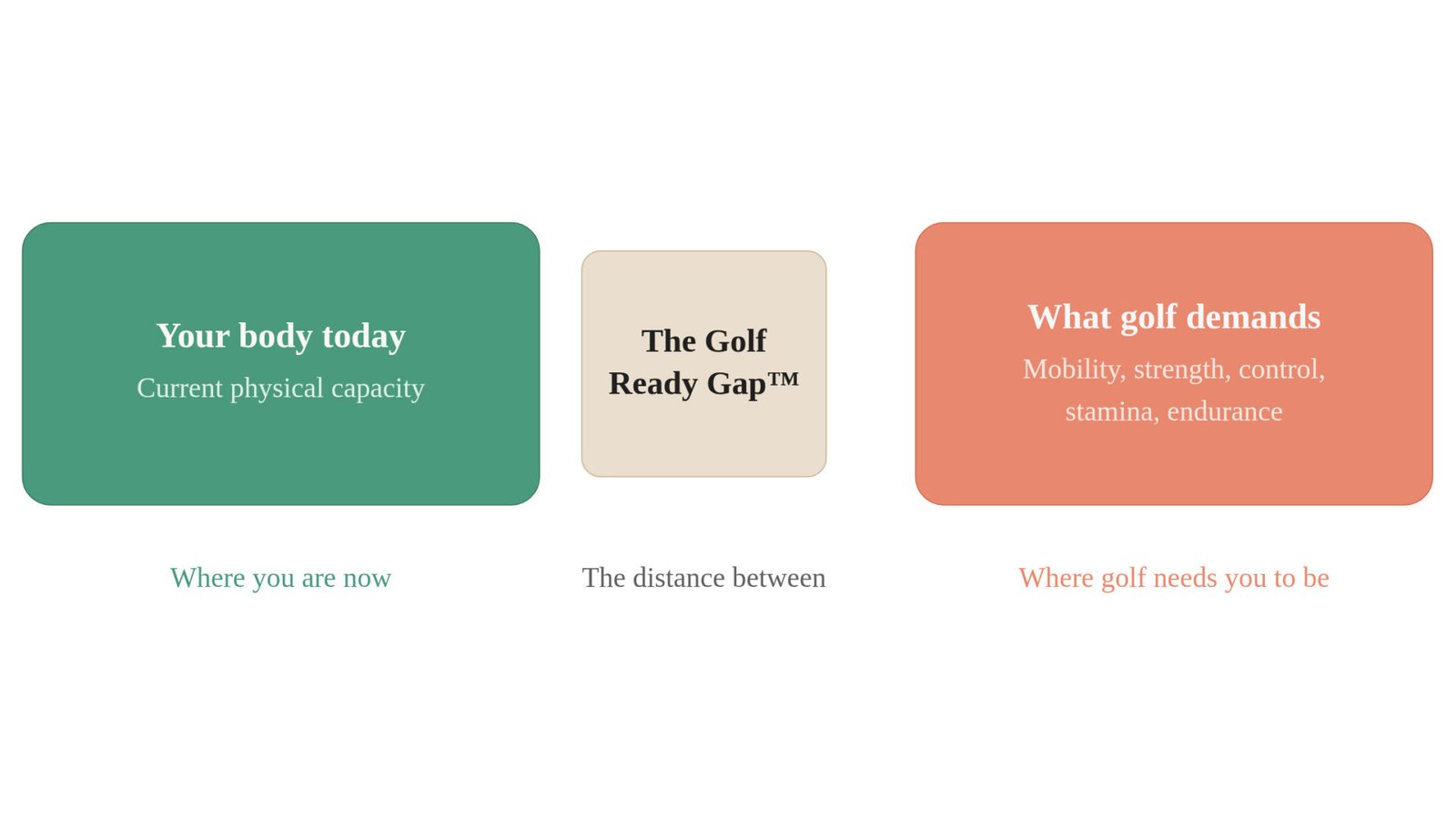
The Golf Ready Gap
This is something I call The Golf Ready Gap.
It’s the difference between your body’s current physical capacity and what your golf swing repeatedly asks it to do.
For some golfers that gap is small.
For others it’s surprisingly large.
You don’t have to be injured to have a Golf Ready Gap. In fact, many golfers don’t notice their Golf Ready Gap until they try to increase their practice, change their swing or play more often.
You might simply notice that:
- You lose distance as the round goes on.
- Your back feels stiff after 18 holes.
- Certain swing changes never feel comfortable.
- You struggle to rotate through the ball.
- You don’t trust your body over awkward lies or uneven ground.
These aren’t always technical problems.
Sometimes they’re signs that your body is asking for something different.
Elite golfers spend years reducing that gap.
Many recreational golfers don’t even realise it exists.
Four Myths I Wish More Golfers Would Stop Believing
Myth 1: “I’m just not flexible enough.”
Golf isn’t won by the person who can stretch the furthest.
It requires the right movement in the right places, combined with strength, control and balance.
The goal isn’t simply to move more.
It’s to move better.
Myth 2: “I just need another lesson.”
Good coaching is invaluable.
But if your body can’t physically achieve the movement your coach is asking for, progress can become frustrating.
Often, improving your physical capacity allows coaching to have a much bigger impact.
Myth 3: “A few aches are just part of getting older.”
Age changes all of us.
But recurring pain shouldn’t automatically be accepted as the price of playing golf.
Many physical limitations can be improved once they’re properly identified.
Myth 4: “If I play more golf, I’ll get better.”
Playing more develops skill.
But if your body is already compensating, more golf may simply reinforce those same compensations.
Sometimes improving your body is the quickest way to improve your golf.
What I See in Clinic
One of the most rewarding parts of my job is helping golfers understand why something is happening.
It’s common for someone to arrive believing they have a swing fault.
Once we assess how they move, the picture often changes.
Perhaps they can’t rotate comfortably through one hip.
Perhaps they’re avoiding loading one leg after an old injury.
Perhaps they’ve gradually lost confidence after experiencing pain.
One thing I notice regularly is that golfers often blame the area that hurts, when the real limitation is somewhere else entirely.
Once those physical limitations are identified and addressed, many golfers find their swing begins to feel more natural, without constantly thinking about mechanics.
The goal isn’t to create a perfect swing.
It’s to create a body that’s capable of supporting the swing you already have.
A Different Way to Watch the AIG Women’s Open
As you watch this week’s tournament, enjoy the incredible golf.
But instead of only following the ball, spend a few moments watching the players themselves.
Notice how balanced they remain after impact.
Watch how effortlessly they transfer their weight.
Observe how stable they are at the finish.
Look at how athletic they appear, even under pressure.
Those aren’t accidents.
They’re the product of bodies that have been prepared to meet the demands of golf at the very highest level.
You don’t need to swing like the world’s best players.
But there is something we can all learn from them.
Not about copying their technique.
About respecting the body that makes that technique possible.
For women returning to golf, taking up the game later in life, or simply playing more regularly, understanding these physical demands isn’t about creating barriers. It’s about building confidence that your body can support the golf you want to enjoy.
Key Takeaways
- The golf swing is only as good as the body producing it.
- Professional golfers invest as much in their physical preparation as their technical practice.
- Every golfer has a unique Golf Ready Gap.
- Improving your physical capacity can make coaching more effective.
- You don’t need a tour swing. You need a body that supports your swing.
Frequently Asked Questions About the AIG Women’s Open and Your Golf
Should I try to copy the swing of a professional golfer?
It’s completely natural to feel inspired by watching the world’s best players, but copying a professional’s swing without considering your own physical capabilities can often lead to frustration.
Rather than asking, “How can I swing like them?”, ask yourself:
“Is my body capable of producing the swing I’m trying to achieve?”
What should I actually be watching during the AIG Women’s Open?
Instead of focusing solely on the club or the ball flight, watch how the players move.
Notice their balance.
Watch how they transfer weight.
Observe how stable they are at the finish.
Those qualities often tell us more about performance than the club itself.
Why do professional golfers make the swing look so effortless?
Elite golfers make difficult movements look easy because they’ve developed the physical capacity to perform them repeatedly.
Behind every swing are years of work on strength, mobility, balance, coordination and recovery.
The swing is simply the visible outcome of a body that’s prepared for the demands of golf.
If professional golfers all have different swings, why are they all successful?
There’s no such thing as one perfect golf swing.
Players on tour all move slightly differently because every body is different.
The common factor isn’t identical technique.
It’s that each golfer has developed a swing that works with their body rather than constantly fighting against it.
Can improving my body really improve my golf?
In many cases, yes.
If your body moves more efficiently, you may find it easier to rotate, generate power, maintain balance and repeat your swing consistently.
It can also help you get more from coaching because your body is better able to perform the movements you’re trying to learn.
What is the Golf Ready Gap?
The Golf Ready Gap is the difference between your body’s current physical capacity and what your golf swing repeatedly asks it to do.
It may explain recurring aches, inconsistent ball striking, loss of distance or why certain swing changes never feel comfortable.
I don’t have any pain. Could my body still be limiting my golf?
Absolutely.
Many golfers have no pain but still have movement restrictions, strength deficits or balance issues that influence their performance.
Addressing those limitations early can improve both performance and long-term enjoyment of the game.
What’s the biggest lesson amateur golfers can take from the AIG Women’s Open?
It isn’t trying to copy a player’s swing.
It’s recognising that great golf starts with a body that’s prepared for the demands of the game.
While most recreational golfers don’t need to train like professionals, making your body more capable of supporting your own swing may be one of the most effective ways to play better golf.
Is Your Body Ready for the Golf You Want to Play?
If you’ve ever wondered why your swing changes don’t seem to last, why you keep picking up the same aches, or why golf feels harder than it should, it may be worth asking a different question.
Instead of asking:
“What’s wrong with my swing?”
Try asking:
“Is my body ready for the swing I’m asking it to perform?”
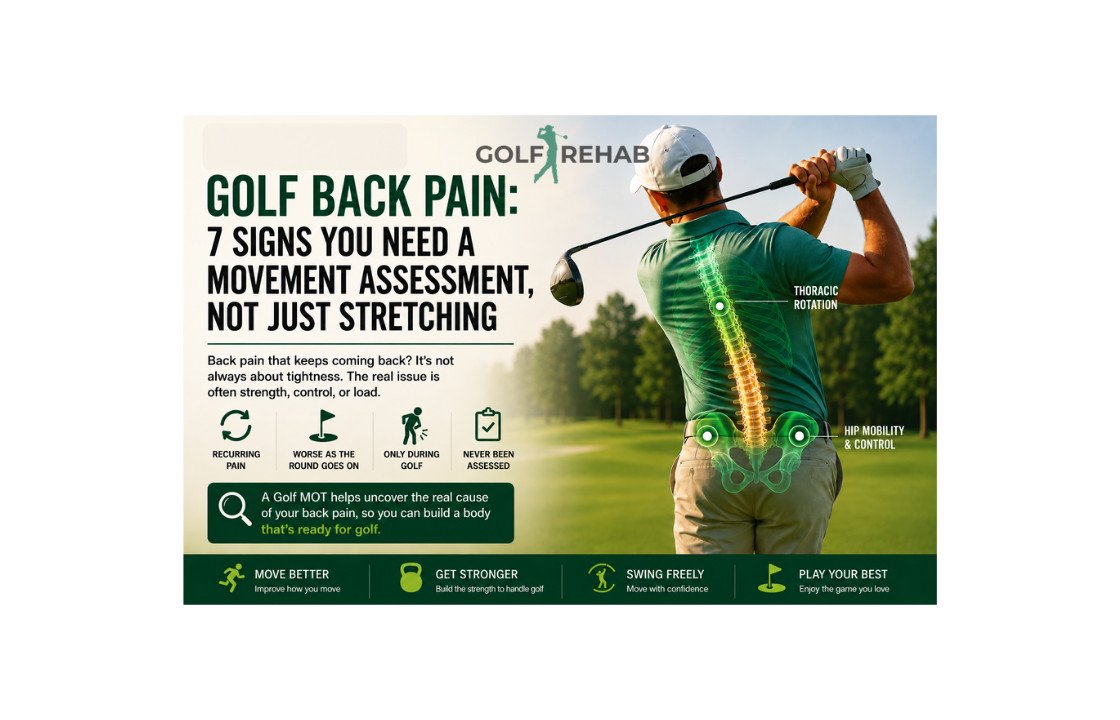
That’s exactly what a Golf MOT is designed to explore.
Rather than looking only at your technique, it assesses how your body moves, where it may be compensating, and whether there’s a gap between what your body can currently do and what your golf swing demands.
Because sometimes the quickest way to improve your golf isn’t changing your swing.
It’s improving the body that creates it.
About the Author
Rachel Sharp is a BASRaT-registered Graduate Sports Rehabilitator with over 20 years of experience helping people recover from injury and improve performance. As the founder of Golf Rehab and a TPI Medical Level 2 Certified clinician, she specialises in helping golfers understand how their body influences the way they move, perform and enjoy the game.