
You start the round moving well. Your swing feels controlled, the strike is reasonably consistent and you trust what your body is doing.
Then somewhere around the back nine, your golf swing gets worse. Your balance becomes less reliable, your timing feels rushed and the movement that felt natural on the first tee suddenly requires far more effort.
So, why does your golf swing get worse when you are tired?
The simple answer is that your swing may not have disappeared at all.
The physical demands of the shot have not changed. But your ability to keep meeting those demands may have.
You might have enough mobility, strength, balance and control to produce your swing early in the round. The bigger question is whether your body can continue producing it as fatigue accumulates.
That is the difference between being able to make a movement once and having the physical capacity to repeat it.
Golf Is More Physically Demanding Than It Looks
Golf does not always look physically demanding. There’s no opposition chasing you, no continuous sprinting and usually plenty of time between shots.
But an 18-hole round can last four or five hours and involve:
Walking several miles over changing terrain
Thousands of steps
Repeated practice swings and full swings
Producing force quickly from relatively static positions
Pushing or carrying equipment
Maintaining concentration and making decisions
Repeating precise movements despite increasing fatigue
A recent study of skilled golfers recorded an average of approximately 17,000 steps and 880 activity calories when players walked a championship course. Heart rate, body temperature and perceived exertion also increased during the round.
Interestingly, the researchers did not find an overall reduction in clubhead speed, ball speed or carry distance compared with using a golf cart. However, measures of lower-body muscle performance declined more after walking.
So walking 18 holes does not automatically wreck your golf swing. Plenty of golfers can maintain their speed despite becoming physically tired.
A physically well-prepared golfer may be able to maintain performance despite accumulating fatigue. Someone with less physical capacity may begin compensating much earlier.
And no, this does not mean every poor back nine can be fixed in the gym. Technique, decision-making, hydration and concentration still matter. But physical capacity deserves to be considered alongside them.
Read the on-course walking study
Why Your Golf Swing Gets Worse as Fatigue Builds
Fatigue does not affect everyone in exactly the same way. Your age, fitness, injury history, playing frequency, nutrition, hydration, course conditions and the physical demands of your individual swing can all influence what happens.
However, fatigue may affect several ingredients involved in producing a repeatable golf swing.
1. Force and speed
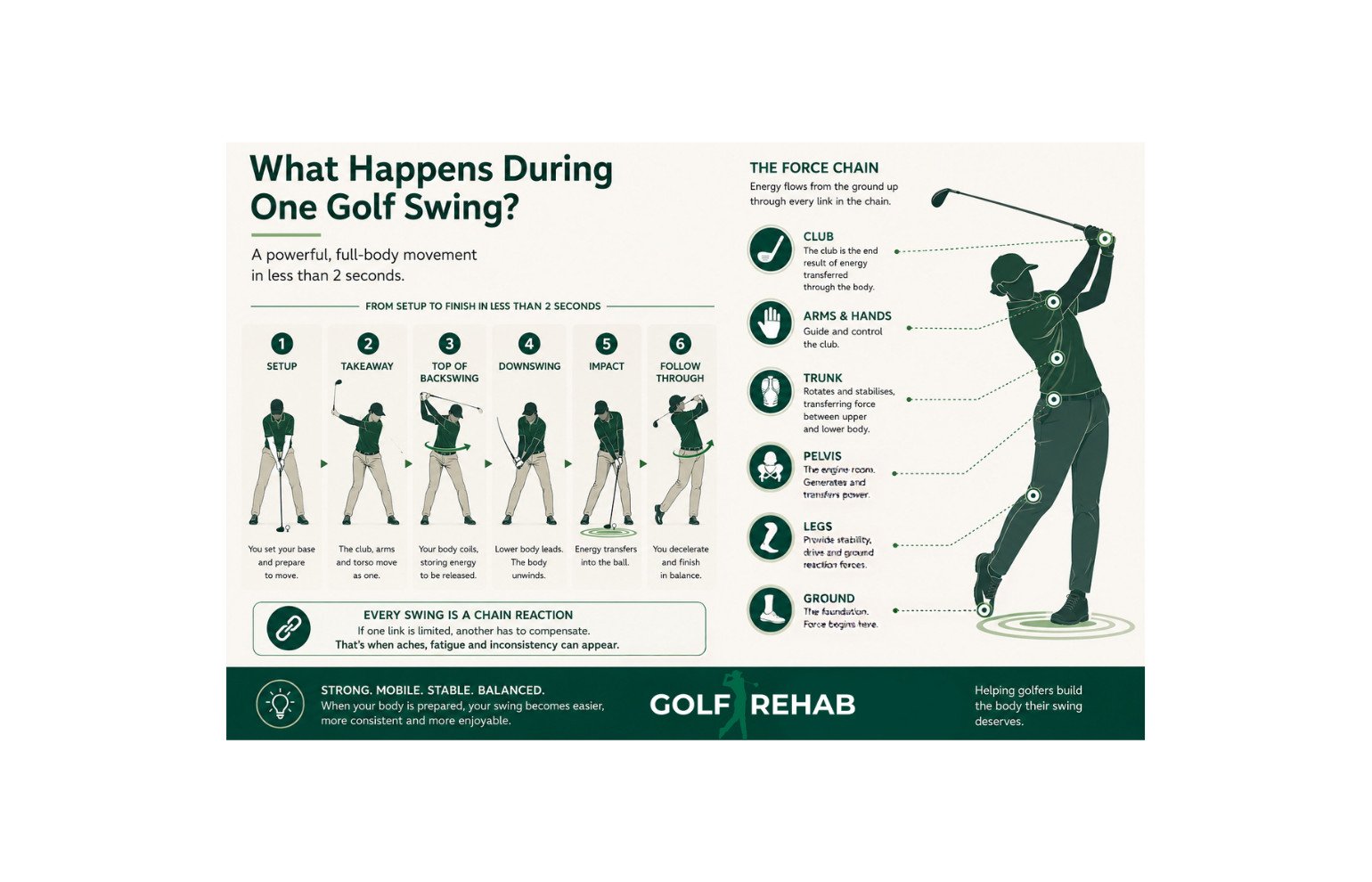
The golf swing requires you to produce force quickly and transfer it through the body to the club.
In one small golf-specific study, seven golfers completed a fatiguing exercise protocol before their swings were reassessed. Fatigue was associated with a reduction of approximately 2 to 2.5% in clubhead speed.
That was a very small study, so it should not be treated as proof that every tired golfer loses a specific amount of speed. It does show that physical fatigue can alter how the body produces a golf swing.
Read the fatigue and golf performance study
2. Coordination and movement control
A golf swing is not simply a test of how far your joints move or how strong individual muscles are.
It requires different parts of the body to move, stabilise and transfer force at the right time.
In other words, having the movement available is not enough. You also need to control it and use it at the right time.
As fatigue builds, maintaining that movement strategy may become more difficult. A golfer might:
Lose control of posture
Struggle to manage pressure through the feet
Rotate differently through the hips or trunk
Rush the transition
Use the arms more when the lower body contributes less
Find it harder to control the finish position
That does not necessarily mean the golfer has suddenly developed a technical fault. It may mean the body is changing its solution because the original one has become harder to maintain.
3. Balance and stability
Good balance is not about standing perfectly still. It is about controlling your centre of mass while different parts of your body are moving quickly.
If lower-body or trunk control begins to reduce, your body may look for another way to complete the swing. You may sway, stand up through the shot, change your foot pressure or shorten the movement.
These adjustments are not your body being stupid. They are your body finding a way to complete the task with the capacity currently available.
Unfortunately, the alternative solution may not produce the strike or ball flight you wanted.
4. Concentration and decision-making
A round of golf is mentally demanding as well as physical.
Every shot involves decisions about distance, club selection, conditions, risk and intended ball flight. You then have to settle over the ball and perform a highly precise movement.
A 2025 systematic review found that mental fatigue may affect several areas of golf performance, particularly putting, but also potentially iron accuracy, driving distance and overall scoring.
The authors were careful to highlight limitations in the evidence. Most of the included studies focused on putting, and it can be difficult to separate mental fatigue from physical fatigue during an actual round.
Even so, most golfers will recognise the experience of making poorer decisions or losing commitment to a shot when concentration begins to fade.
Read the systematic review of mental fatigue in golf
Why Another Swing Thought May Not Fix It
When shots begin to deteriorate, most golfers respond by adding another swing thought.
Keep your head down. Slow the backswing. Turn more. Stay in posture. Do not come over the top.
Occasionally, that cue helps.
But if the underlying problem is that your body is struggling to keep producing the movement, adding more technical instructions may simply give a tired brain another job.
This does not mean your golf coach is wrong.
Good technical coaching is enormously valuable. But even excellent instruction still has to be carried out by your body.
If you have been working hard on your technique but the same problems keep returning, particularly later in a round, it may be worth reading Why Your Golf Lessons Aren’t Working.
Sometimes the instruction is right, but the physical capacity required to repeat it is not yet there.
Being Able to Do It Once Is Not the Same as Owning It
This is one of the most important distinctions in rehabilitation and physical performance.
A golfer might be able to:
Rotate well during an assessment
Balance on one leg for a short test
Produce a strong movement once
Swing at full speed on the range
Play nine holes without difficulty
None of those automatically tells us what happens after several hours of walking, swinging and concentrating.
The real question is not only:
Can your body produce the movement?
It is also:
Can your body continue producing and controlling it when the demands are repeated?
If a movement requires nearly everything you currently have, it may be available when you are fresh but become harder to access when you are tired.
If your physical capacity comfortably exceeds the demands of the task, you have more room before fatigue starts affecting how you move.
That is why improving golf performance is not always about creating a bigger or more athletic-looking swing. Sometimes it is about making your existing swing less physically expensive to repeat.
This May Be Part of Your Golf Ready Gap
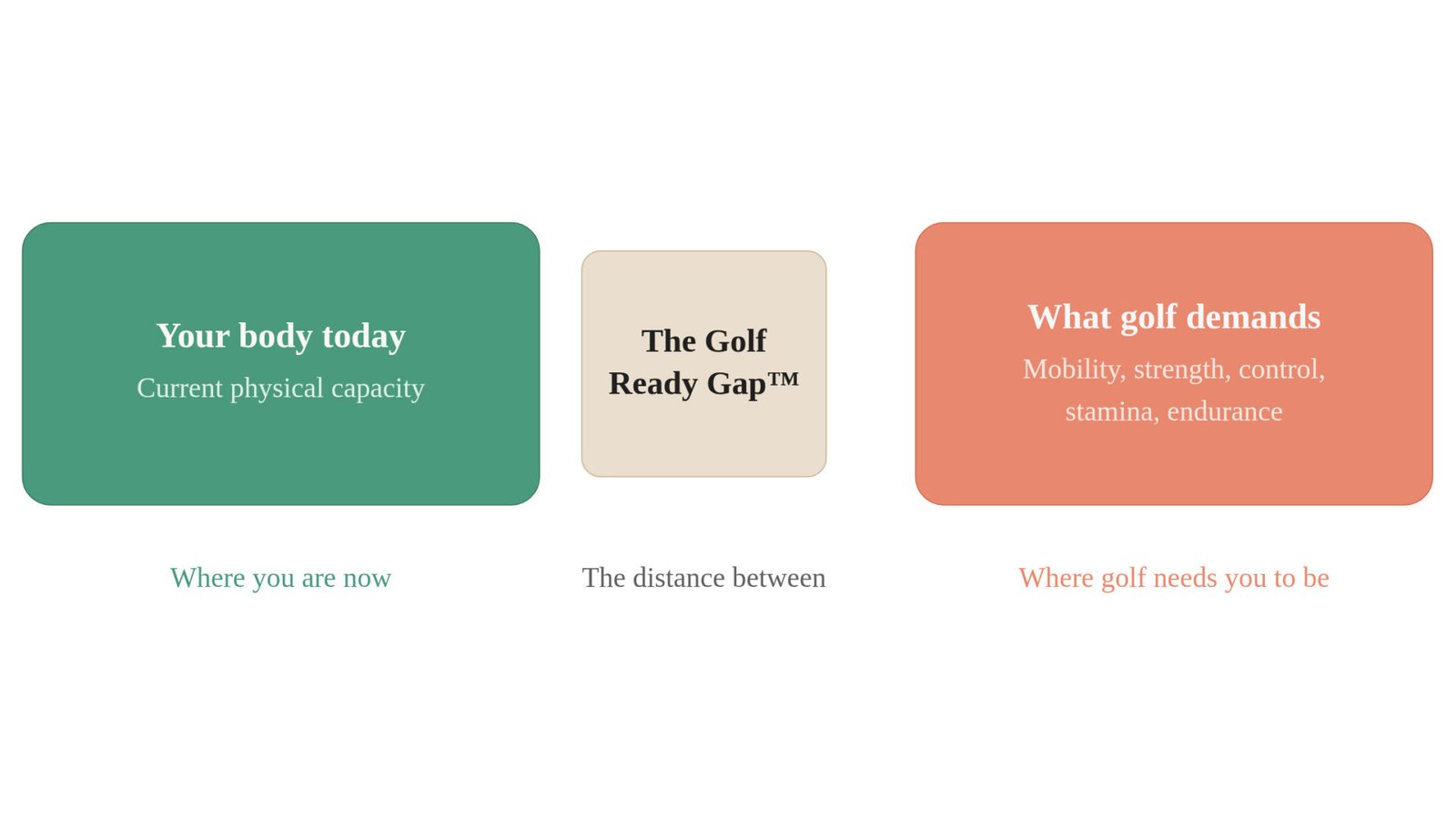
The Golf Ready Gap is the difference between what your golf requires and what your body can currently deliver.
For one golfer, that gap may involve hip or thoracic mobility. For another, it may be lower-body strength, balance, rotational control or the ability to tolerate repeated force.
Fatigue can make that gap easier to see.
Early in the round, your body may have enough capacity to work around a limitation. As the round progresses, that strategy may become harder to maintain. Movement changes, compensations become more obvious and the swing feels less predictable.
That does not prove every back-nine problem is physical. Technique, confidence, course management, hydration, nutrition and concentration may all contribute.
But if your swing regularly changes as the round progresses, your physical capacity deserves a place in the conversation.
Learn more about the Golf Ready Gap.
How Can a Golf MOT Help?
A Golf MOT looks at the body producing your golf swing rather than trying to replace the work of your golf coach.
The assessment can explore areas such as:
Hip and thoracic mobility
Pelvic and trunk control
Balance and single-leg stability
Strength and power
Left-to-right differences
Rotational movement
Previous injuries
Your ability to tolerate the repeated demands of golf
The aim is not to search for faults or force every golfer into the same movement.
It is to understand what your body can currently do, how that compares with the golf you want to play and where greater physical capacity may help.
Your Swing May Not Be the Only Thing Getting Tired
If your swing feels good early in the round but repeatedly changes on the back nine, do not immediately assume you have forgotten how to play golf.
Ask a better question:
Does my body have enough capacity to keep producing this swing for the whole round?
Your technique still matters. Your golf coaching still matters. But the body has to support both.
The demands of the shot have not suddenly increased.
Your ability to keep meeting them may have changed.
And that difference between what your golf demands and what your body can repeatedly deliver may be part of your Golf Ready Gap.
If you would like to understand what may be limiting your own movement, strength or ability to repeat your swing, a Golf MOT provides a physical baseline and a clear place to start.
Research referenced
Higdon NR, Finch WH, Leib D, Dugan EL. Effects of fatigue on golf performance. Sports Biomechanics. 2012;11(2):190–196.
O’Donnell A et al. Riding a Golf Cart Versus Walking: A Study on the Physiological and Performance Differences in Tournament Golf. European Journal of Sport Science. 2025.
Pan X et al. Mental fatigue in golf: A systematic review. 2025.